
The Yeshuan Model
How does faith function when religion, condemnation, and external spiritual authorities are no longer operative?
Fundamental to the Yeshuan Model is the discovery that the central claims of Christianity have already been fulfilled in history. We both teach the justifications for this assumption (preterist eschatology and its consequences) and explore – what do we do now?
Biblical Framework
Providing the Original Justifications for Subjective (Non-Collective) Faith
LOGOS
The Yeshuan Model arises from the premise that historical record indicates that biblical age of religion has ended. We understand this is a major claim, and provide over 10,000 hours of in-depth research to help explain. Below are the main biblical tenants of what we discovered and teach.
Click to view the main points in our biblical framework
Biblical Fulfillment
Sometimes called Preterist Eschatology – Apostolic prophecy concerning the coming of Christ, judgment, and the end of the age was fulfilled in first-century events culminating in the destruction of Jerusalem in A.D. 70.
End of Satan, Death, Hell
These conditions belonged to the Old Covenant age and no longer govern humanity after fulfillment.
Reconciled Soteriology
Salvation is complete in Christ, reconciliation is present, and subjective faith participates in an accomplished reality.
Ontology of God
We are critical of creedal Trinitarianism, and how it is used as a tool to confuse and manipulate God materially. We suggest God is one “perfect plural” being whose Father, Son, and Spirit are temporal manifestations, with Yeshua’s obedience, death, and resurrection revealing the Spirit of Christ in this Age.
The Four L’s and The Four Traits
An Approach to Growing in Faith Without Religion
ETHOS
The Four L’s and Four Traits are articulated tools to help individuals navigating life directly with God without appealing to any other external authorities like doctrines, denominations, or cultural preferences. We aim to spiritually fortify individuals and their “autonomy of person”.
Click to view the Four L’s and the Four Traits
The Four L’s of the “Wash Cycle”
The Wash Cycle describes humility before certainty, openness to the other, selfless love amid difference, and liberty from fear, coercion, and religious pressure.
- Seeking Light – putting humility before certainty
- Disposition toward Learning – voluntary openness to the “other”
- Demonstrating Agape Love – selfless acceptance amid difference
- The Fruit of Liberty – freedom from fear, coercion, and religious pressure toward division
Four Traits of the Rinse Cycle
The Rinse Cycle describes the exposure of the soul’s limits, surrender without answers, clarity without grasping, and compassion without demand.
- Despair – exposure of the soul’s limits
- Leap of Faith – surrender without answers
- Spiritual Perspicuity – gaining clarity without perfect knowledge
- Ultimate Spiritual Maturity – relentless compassion
These elements neither prove faith but help individuals fortify the heart’s orientation toward God within a materially constrained life.
Religious Deconstruction
Studying Religion & How it Keeps People in Bondage
PATHOS
Based on the biblical framework proposed above, we assert that all claims to authority in God asserted by doctrine, religion, denomination, lifestyle, philosophy, politic, or any other material condition is completely unfounded; we boldly suggest that religion is an earthly endeavor that starts and ends in this realm, and has no direct affiliation to God. We have done a lot of work for ourselves and for others to expose the harmful tactics deployed by religious entities to conflate themselves with God for power, especially Mormonism, Evangelicalism and Calvinism.
Click to view the Four L’s and the Four Traits
The Four L’s of the “Wash Cycle”
The Wash Cycle describes humility before certainty, openness to the other, selfless love amid difference, and liberty from fear, coercion, and religious pressure.
- Seeking Light – putting humility before certainty
- Disposition toward Learning – voluntary openness to the “other”
- Demonstrating Agape Love – selfless acceptance amid difference
- The Fruit of Liberty – freedom from fear, coercion, and religious pressure toward division
Four Traits of the Rinse Cycle
The Rinse Cycle describes the exposure of the soul’s limits, surrender without answers, clarity without grasping, and compassion without demand.
- Despair – exposure of the soul’s limits
- Leap of Faith – surrender without answers
- Spiritual Perspicuity – gaining clarity without perfect knowledge
- Ultimate Spiritual Maturity – relentless compassion
These elements neither prove faith but help individuals fortify the heart’s orientation toward God within a materially constrained life.
The “Next Age”
Keeping the Model Open to Change and Evolution
KAIROS
We live and teach that the Spirit of Christ is directly accessible to all humans, despite their ontological knowledge of Him, and is witnessed and manifest through any expression of agape love. This is not owned or facilitated by any specific collective entity, especially religious, and only occurs between and individual and God. Below are some key principles at play in this next age of God working with humanity.
We host an annual leadership program, where participants face the materials of their own lives to learn how to better their subjective faith and love in this life. Leadership program graduates join our ThinkTank, bringing their unique perspectives to the Yeshuan Model so that we always remain open to change and growth.
Click to view how we perceive this “Next Age” after material religion to function
Shifted Manifestation of God
God is no longer manifested through external structures but encountered inwardly through the Spirit of Christ as lived faith.
Garden State
Through the fulfilled work of Christ, humanity exists in a restored spiritual Garden where we orient ourselves between the “Two Trees”, but now punishment has been covered.
Spirit of Man vs. Spirit of Christ
The Spirit of Man governs this world (material systems). while the Spirit of Christ in the eternal realm, meeting us at an individual level only.
Materiality and the Soul
The soul is the “materially conditioned person”. Religion seeks to reform the soul to reach the heart; Yeshuan Model reverses this order.
Orientation of the Heart
The heart is the locus of intention where faith is shaped through the continual negotiation between the two Spirits.
God discerns the heart above outward behavior.
Faith & the Limits of Knowledge
Faith begins where knowledge ends by accepting uncertainty and remaining open to being wrong.
Relational Over Material
Spiritual growth is discerned through relational disposition rather than material, religious, or cultural association.
Are you a Yeshuan? Find out →
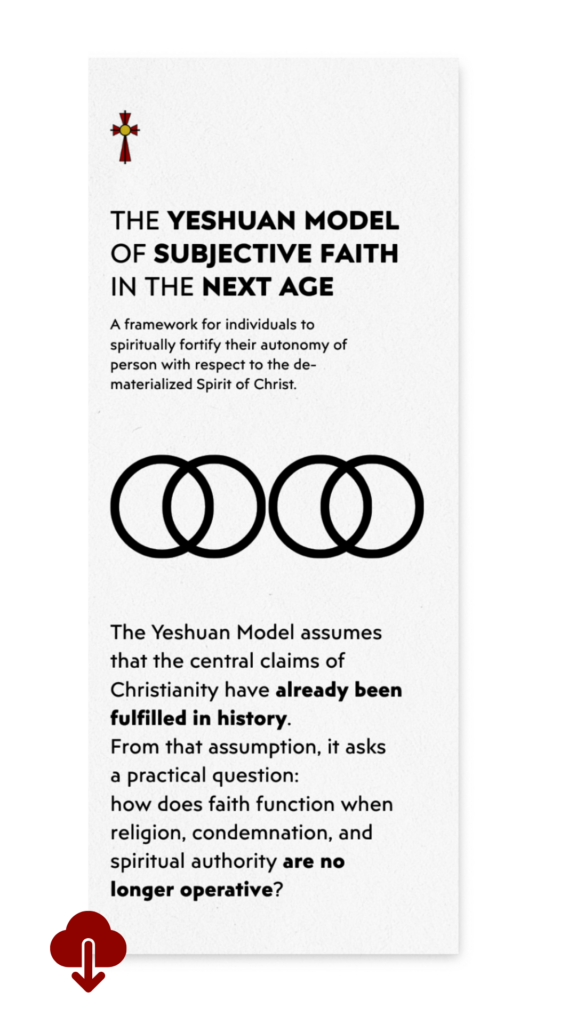
Download the Yeshuan Model Pamphlet
The content above has been formatted into a pamphlet download that you can print and use as needed. Click below to download,
More info…
Preview Yeshuans App
You can preview and browse the Yeshuans App anytime at the links below.