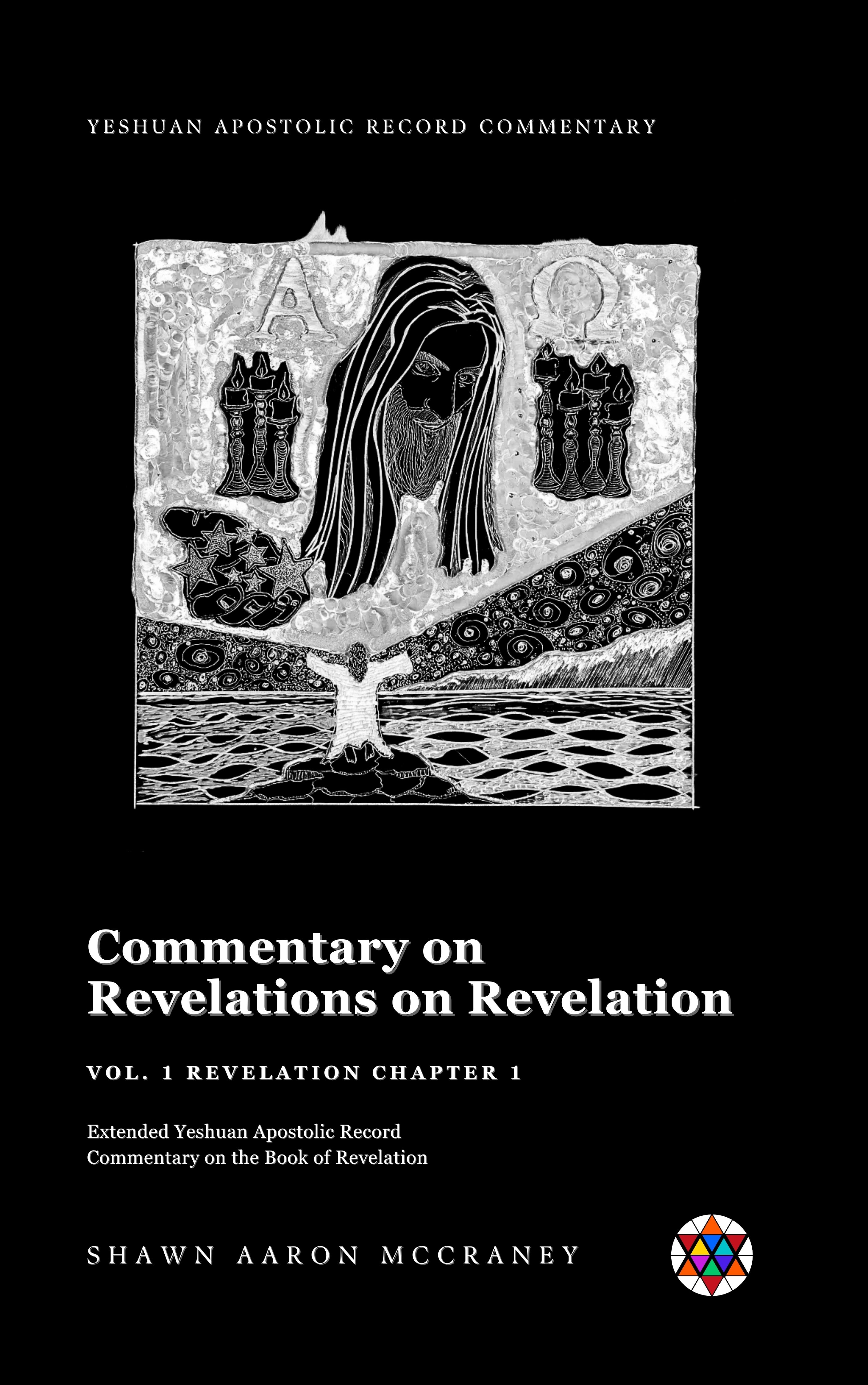
Revelation Chapter 1 Commentary
Expanded Yeshuan Apostolic Record Commentary on the Book of Revelation
This 22-volume collection offers a chapter by chapter expanded commentary on the book "Revelations on Revelation" by Shawn McCraney. This collection is a part of the Yeshuan Apostolic Record Commentary Collection, offering extended insights and clarifications on the entire purpose and place of the Apostolic Record (typically referred to as the New Testament) from a fulfilled perspective. It includes significant facts from various translations, commentaries, and historical contexts, as it expands on the footnotes in Revelations on Revelation. Volume 1 opens the collection with an overview of the four main ways the Book of Revelation has been read: idealist, preterist, historicist, and futurist. It weighs the strengths and problems of each before turning to a verse-by-verse study of Revelation chapter 1, from the opening words of the revelation of Jesus Christ through John's vision of the glorified Christ among the seven candlesticks and seven stars.

Sample: Overview to Revelation
Generally speaking, there are four main views or ways people read or interpret the Book of Revelation. Perhaps the easiest way to summarize these four main views would be:
- The Idealist View means the contents of the revelation will never to be fulfilled.
- The Preterist View means that the contents of the revelation has been fulfilled.
- The Historicist View means that the contents of the revelation is being fulfilled, and
- The Futurist View means that the contents of the revelation will someday be fulfilled.
To make matter more confusing, within each of these views lies an innumerable number of sub-stances people take which further divides the body on perspective and interpretation of this quixotic work.
The Idealist view of Revelation essentially teaches that the book is allegorical and must be read through spiritualized eyes and not assigning actuality of the contents to the events described.
The Preterist view – both partial and full – which say that the contents of Revelation was written to the Seven Churches of that day and that most (partial) or all (full) of its contents described occurred prior to the 70 AD destruction of Jerusalem by the Roman Army. The main differences between the partial and full Preterist positions might be that partial Preterists believe the contents of Revelation have been fulfilled up to chapters 20, 21 and 22 and full preterists believe the entire book is complete.
The Historicist view suggests that themes and events of the Revelation are being played out over the course of Christian history, and even repeated in some cases. Elements of the Historicist view can be quite compelling as it teaches that Revelation is a symbolic representation of the course of Christian history (beginning with the age of the apostles and working its way through to the end of the Christian age - or what historicists believe would be the end of the world).
As an example, when we get to the actual seven churches mentioned in the book, a historicist would see them as representing a period of time (or age) in church history. So instead of Jesus having John speak to an actual Church at Ephesus, a Historicist would see . . .
- The age of Ephesus is representing the apostolic age.
- The age of Smyrna is the persecution of the Church through AD 313.
- The age of Pergamus is the compromised Church lasting until AD 500.
- The age of Thyatira is the rise of the papacy to the Reformation.
- The age of Sardis is the age of the Reformation.
- The age of Philadelphia is the age of evangelism.
- The age of Laodicea represents liberal churches in a "present day" context.
Admittedly, this interpretation can reasonably fit and it goes without saying that most historicist interpreters place the events of our day as being described in the later chapters of Revelation. Were we to examine the actual chapters of Revelation a historicist might say that . . .
- Chapters 1-3 present the seven periods in church history.
- The breaking of the seals in chapters 4-7 symbolizes the fall of the Roman Empire.
- The Trumpet judgments in chapters 8-10 represent the invasions of the Roman Empire by the Vandals, Huns, Saracens, and Turks.
- Then among Protestant historicists of the Reformation, the antichrist in Revelation was believed to be the Catholic papacy.
- Chapters 11-13 in Revelation represent the true church in its struggle against Roman Catholicism.
- The bowl judgments of Revelation 14-16 represent God’s judgment on the Catholic Church, culminating in the future overthrow of Catholicism depicted in chapters 17-19.
- And of course, like the partial preterist suggest, chapters 20-22 describe the end of all things.
John Walvoord, scholar and one-time President of Dallas Theological Seminary points out the severe lack of agreement among historicists saying,
“As many as fifty different interpretations of the book of Revelation therefore evolve, depending on the time and circumstances of the expositor.”
Over a hundred years ago Moses Stuart made the same complaint, saying:
“Hithertho, scarcely any two original and independent expositors have agreed, in respect to some points very important in their bearing upon the interpretation of the book.”
Another problem with the historicist view is it focuses mostly on the events of the church in Western Europe and says very little about the church in the East. Thus, its narrow scope fails to account for God’s activity throughout Asia and the rest of the world. Also, this view would have little significance for the church of the first century whom John was addressing meaning it is highly unlikely that believers in that day would have been able to interpret Revelation as the historical approach suggests.
Prominent scholars who held this view include John Wycliffe, John Knox, William Tyndale, Martin Luther (though he questioned the validity of the book all together), John Calvin, Ulrich Zwingli, John Wesley, Jonathan Edwards, George Whitefield, Charles Finney, C. H. Spurgeon, and Matthew Henry. It was a view that obviously came into prominence during the Protestant Reformation because of its identification of the pope and the papacy with the beasts of Revelation 13.
However, it seems that since the beginning of the twentieth century, the historicist view has declined in popularity and influence as futurism has become a more widely accepted perspective in the last 100 years or so. Before speaking to the futurist view, an observation about it:
The futurist seems to attract people who have a need to project their fears and desires right into the text making the text immediately “applicable” to whomever is reading it at whatever point in history. This is supported by the fact that thousands of modern events have been assigned to the book and have proven to have no application at all. Nevertheless, the Futurist view appears to have more legs than any other view on earth today.
It has been said that a futurist reads the Bible “with a newspaper in their hands.” It takes and teaches that the events of the Olivet Discourse and Revelation (chapters 4-22) will occur (obviously) in the future. Futurist divide the book of Revelation into three general sections which John lays out in verse 19 of chapter one, saying:
“what you have seen, what is now and what will take place later.”
To the futurist, Chapter 1 describes the past (“what you have seen”), chapters 2-3 describe the present (“what is now”), and the rest of the book describes future events (“what will take place later”).
Futurists apply what is called a literal approach to interpreting Revelation. Admittedly, this approach can make some sense – especially with “a newspaper in the other hand.”
So, as said, chapter 1 describes “what was seen,” chapters 2-3 are “what is now” but then chapters 4-19 refer to a period known as the seven-year tribulation and are related to the Book of Daniel 9:27. Some futurists believe that the righteous will escape the contents of verses 4-19 (are known as “Pre-tribbers”) meaning that they will be raptured before the tribulation described in chapters 4-19. Others who see believers being saved after the tribulation are called “post-tribbers.” During the tribulation they say that God’s judgments are actually poured out upon mankind which are described in the book as “seals, trumpets, and bowls.”
To a futurist chapter 13 describes a literal future world empire headed by a political leader and a religious leader that are represented by two beasts. Chapter 17 pictures a harlot (who represents the church in apostasy) and chapter 19 refers to Christ’s second coming and the battle of Armageddon followed by a literal thousand-year rule of Christ upon the earth (which is seen in chapter 20). Finally, chapters 21-22 are events that follow the millennium which the Futurist sees as the creation of a literally “new heaven and a new earth” with the arrival of the heavenly city upon the earth.
Again, futurists argue that a consistently literal or “plain interpretation” is to be applied in understanding the book of Revelation. Literal interpretation of the Bible means to explain the original sense, or meaning, of the Bible according to the normal customary usage of its language. This means applying the rules of grammar, staying consistent with the historical framework and the context of the writing. Literal interpretation does not necessarily discount figurative or symbolic language but we already have seen that even the futurists attempts at remaining literal are impossible with this book as they believe “this and such” represents “thus and this.” That being said, Futurists teach that prophecies using “symbolic language” are also to be normally interpreted according to the laws of language. J. P. Lange, a Calvinist Theologian of old stated,
“The literalist (so called) is not one who denies that figurative language, that symbols, are used in prophecy, nor does he deny that great spiritual truths are set forth therein; his position is, simply, that the prophecies are to be normally interpreted (i.e., according to the received laws of language) as any other utterances are interpreted – that which is manifestly figurative being so regarded.”
Charles Ryrie, a proponent of premillinialist dispensationalism and Professor at Dallas said:
“Symbols, figures of speech and types are all interpreted plainly in this method, and they are in no way contrary to literal interpretation. After all, the very existence of any meaning for a figure of speech depends on the reality of the literal meaning of the terms involved. Figures often make the meaning plainer, but it is the literal, normal, or plain meaning that they convey to the reader."
While futurists will acknowledge the use of figures and symbols in the Revelation, they say that when figurative language is used a person must look at the context to find the meaning. At the same time, they maintain that figurative language does not justify allegorical interpretation. The key to knowing how to literally interpret figurative symbolism for the Futurist often comes from an understanding of the ancient church fathers.
For example, the idea of a future millennial kingdom is found in the writings of Clement of Rome (AD 96), Justin Martyr (AD 100-165), Irenaeus (AD 115-202), Tertullian (AD 150-225) and others.
Futurists maintain that the “church fathers” taught a literal interpretation of Revelation until Origen (AD 185-254) who was the one who introduced allegorical (Idealist) interpretation. This then became the popular form of interpretation and was taught by Augustine (AD 354-430). The Futurist maintains that the literal interpretation of Revelation was a constant throughout the history of the church but rose again to prominence in this the modern era.
One of the most popular versions on futurist teaching is called dispensational theology, promoted by schools such as Dallas Theological Seminary and Moody Bible Institute. Theologians such as Charles Ryrie, John Walvoord, and Dwight Pentecost are noted scholars of this position. Again, one of the drawbacks to the Futurist position occur when people apply the futurist approach to current events to the symbols in Revelation. This habit has become a constant embarrassment to the body. Additionally, many – for over a thousand years - have actually been involved in setting dates of Christ’s return!
Additionally, one of the major problems with the Futurist view is that in most ways it renders the contents of the book irrelevant to the original readers from the first century. In other words, why would the Revelation begin by saying it was to the actual, literal “seven churches” but 80% of its contents have nothing to do with them/then, their lives or their age?
Another criticism of the Futuristic views is that Revelation is obviously apocalyptic literature and was thus meant to be interpreted allegorically or symbolically rather than literally. Bible enthusiast Hank Hanegraaff makes an interesting point, saying,
“When a Biblical writer uses a symbol or an allegory, we do violence to his intentions if we interpret it in a strictly literal manner.”
So, these are the four views of Revelation – the Idealist, the Preterist, the Historicist and the Futurist. Perhaps there is another view that has never really found a real home in the hearts of Christians today and it’s time to consider it? We might call it the, “we-ought-to-question-the books-place-in-the-word-in-the-first-place” view.
Because we live in a time where Bible worship is almost as fervent as Jesus worship, this view is unlikely to ever get legs, but let’s include it in our scope for the following reasons:
- Eusbius’s words and Luther’s words. And,
- What may be seen as a general fail in terms of overall application, consistence and value to the modern reader.
First, to Luther’s views of the book. A simple online search will provide the specifics but to summarize, the following was printed in his preface to the Revelation of St. John 1522:
“Christ is neither taught nor known in it.”
Of course, this is hyperbole, and the intent must have been to say that the Christ of the Apostolic Record, the Jesus believers have come to know and love, is missing. Admittedly, one of the things about the Word of God that is beautiful is the utter consistency of its central message of God’s grace to Man. We discover (through studies) a consistency to the New Testament books but presently this consistency is lacking in the Book of Revelation. Additionally, where there is consistency between the Gospel of John and the Epistles of John I again fail to see a consistency in the book ascribed as coming from his hand in the Book of Revelation – both through linguistic comparison (of the Greek) or in the tenor or tone of the message given.
In some beneficial ways the Book of Revelation fully addresses the completion of a very Jewish Age – which is why it’s message is so consistent with books of the Old Testament like Daniel and Ezekiel. However, is the book consistent with the teachings of God made flesh (Jesus of Nazareth)? Is it consistent with the Message of Paul to the Gentile world? This is one reason why its authorship may be in question; it appears, in many ways, to be the workmanship of a Jew and not a Jew converted to Christ (especially a Jew converted to Christ who was one of His main apostles known as the Beloved). We might begin our examination of Revelation through this view by asking these questions as we read through its contents:
1. Would Jesus demand little children to die because their parents sinned?
2. Would Jesus and or Paul change salvation by faith back to salvation by works/righteousness?
3. Would Jesus direct his disciples to rule with an "iron rod" instead of with love and forgiveness like He taught them?
4. Would Jesus vomit you (and me) out of the Kingdom of God for being a little warm and not red hot in our faith-walk?
5. Would Jesus send us to hell for not believing every word of the Book of Revelation, revoking his promise to “never leave us and to be with us forever?” (This was one of Luther’s complaints of the Book – that the author made this book more important than any other book in scripture.) And . . .
6. Would Jesus tell you he is coming soon . . . and then not come?
Really think about this – believers are thoroughly commanded to believe and love and trust in God’s GRACE – but are told here that if (in a time of trial and utter desperation) they accept a mark in our flesh as a means to materially survive (to buy and sell goods) they will lose their salvation and there is no way out?
When we compare Revelation to the message of the Gospels and Epistles we might again wonder about its consistency. The peace that is present in the messages of the gospels and the epistles is almost lost when we consider the words of Jesus to the seven Churches. He is not the Jesus we normally recognize. Perhaps something is being lost in translation – we’ll find out. Nevertheless a simple reading of Revelation shows its contents directly disputes all twenty-six books preceding it. Putting it another way (a much more troubling way, frankly) Revelation teaches opinions and attitudes contrary to those of Jesus and his Apostles – especially Paul.
That the Book of Revelation was always accepted in early Christianity is only partially true. One of the most well studied and well-read apologists of Christianity, Nathaniel Lardner, who lived from 1684 to 1768, took a serious look at early church support for the book. This is a summary of what he discovered:
"We are now come to the last book of the New Testament, the Revelation; about which there have been different sentiments among Christians; many receiving it as the writing of John the apostle and evangelist, others ascribing it to John a presbyter, others to Cerinthus, and some rejecting it, without knowing to whom it should be ascribed. I shall therefore here rehearse the testimony of ancient Christians, as it arises in several ages.
"It is probable that Hermas read the book of the Revelation, and imitated it; he has many things resembling it. It is referred to by the martyrs at Lyons. There is reason to think it was received by Papias. Justin Martyr, about the year 140, was acquainted with this book, and received it as written by the Apostle John; for, in his dialogue with Trypho, he expressly says:
'A man from among us, by name John, one of the apostles of Christ, in the revelation made to him, has prophesied that the believers in our Christ shall live a thousand years in Jerusalem; and after that shall be the general, and, in a word, the eternal resurrection and judgment of all together. To this passage we suppose Eusebius to refer in his ecclesiastical history, when giving an account of Justin's works, he observes to this purpose. He also mentions the Revelation of John, expressly calling it the apostle's. Among the works of Melito, Bishop of Sardis, one of the seven Churches of Asia, about the year 177, Eusebius mentions one entitled, 'Of the Revelation of John.'
It is very probable that Melito ascribed this book to the apostle of that name, and esteemed it of canonical authority. Irenaeus, bishop of Lyons in Gaul, about A.D. 178, who in his younger days was acquainted with Polycarp, often quotes this book as the Revelation of John, the apostle of the Lord. And in one place he says: 'It was seen not long ago, but almost in our age, at the end of the reign of Domitian.'
"Theophilus was bishop of Antioch about 181. Eusebius, speaking of a work of his against the heresy of Hermogenes, says:
'He therein made use of testimonies, or quoted passages, from John's Apocalypse.
The book of the Revelation is several times quoted by Clement of Alexandria, who flourished about 194; and once in this manner (saying):
'Such a one, though here on earth he is not honored with the first seat, shall sit upon the four and twenty thrones judging the people, as John says in the Revelation.'
Tertullian, about the year 200, often quotes the Revelation, and supposes it to have been written by St. John, the same who wrote the First Epistle of John, universally received:
'Again, the Apostle John describes, in the Apocalypse, a sharp two-edged sword coming out of the mouth of God.' He also says: 'We have Churches that are the disciples of John. For though Marcion rejects the Revelation, the succession of bishops, traced to the original, will assure us that John is the author: “by John undoubtedly meaning the apostle.”
Lardner continues . . .
"From Eusebius we learn that Apollonius, who wrote against the Montanists about 211, quoted the Revelation. By Caius, about 212, it was ascribed to Cerinthus: it was received by Hippolytus about 220, and by Origen about 230. It is often quoted by him. He seems not to have had any doubt about its genuineness. In his Commentary upon St. John's gospel, he speaks of it in this manner:
'Therefore John, the son of Zebedee, says in the Revelation.'
Dionysius, bishop of Alexandria, about 247, or somewhat later, wrote a book against “the Millenarians,” in which he allows the Revelation to be written by John, a holy and divinely inspired man. But he says, 'He cannot easily grant him to be the apostle, the son of Zebedee, whose is the gospel according to John, and the catholic epistle.'
He rather thinks it may be the work of “John an elder,” who also lived at Ephesus in Asia, as well as the apostle. It also appears, from a conference which Dionysius had with some Millenarians, that the Revelation was, about 240 and before, received by Nepus, an Egyptian bishop, and by many others in that country; and that it was in great reputation.
It was received by Cyprian, bishop of Carthage, about 248, and by the Church of Rome in his time, and by many Latin authors. The Revelation was received by Novatus and his followers, and by various other authors. It is also probable that it was received by the Manichees. It was received by Lactantius, and by the Donatists; by the latter Arnobius about 460, and by the Arians.
So, there is the “early support” mentioned. But let’s read on as Lardner adds:
"In the time of Eusebius, in the former part of the fourth century, it was by some not received at all; and therefore it is reckoned by him among contradicted books. Nevertheless, it was generally received. Eusebius himself seems to have hesitated about it, for he says:
'It is likely the Revelation was seen by John the elder, if not by John the apostle.'
It may be reckoned probable that the critical argument of Dionysius of Alexandria was of great weight with him and others of that time. The Revelation was received by Athanasius, and by Epiphanius; but we also learn from him that it was not received by all in his time. It is not in the catalogue of Cyril of Jerusalem, and seems not to have been received by him. It is also wanting in the catalogue of the Council of Laodicea, about 363.
"The Revelation is not in Gregory Nazianzen's catalogue; however, it seems to have been received by him. It is in the catalogue of Amphilochius; but he says it was not received by all. It is also omitted in Ebedjesus' catalogue of the books of Scripture received by the Syrians; nor is it in the ancient Syriac version. "It was received by Jerome; but he says it was rejected by the Greek Christians. It was received by Rufin, by the third Council of Carthage, and by Augustine, but it was not received by all in his time. It is never quoted by Chrysostom, and probably was not received by him. It is in the catalogue of Dionysius, (called the Areopagite) about 490.
It is in the Alexandrian MS. It was received by Sulpicius Severus about 401; and by J. Damascenus, and by OEcumenius, and by many other authors. Andrew, bishop of Caesarea, in Cappadocia, at the end of the fifth century, and Arethas, bishop of the same place, in the sixth century, wrote commentaries upon it. But it was not received by Severian, bishop of Gabala; nor, as it seems, by Theodoret. Upon the whole, it appears that this book has been generally received in all ages, though some have doubted of it, and rejected it; particularly the Syrians, and some other Christians in the east.
In the end, Revelation wasn’t generally accepted as canon or beneficial until the year 508 AD. Some ancient Christian branches still do not include it in their Bibles. So, from both Luther’s comments about the Book, this information on the Eastern Church and the fact that it was not fully embraced, we can see that criticism of “Revelation” is not new and is not necessarily a disrespectful or heretical stance.
Its acceptance by the Roman Church does nothing to change the uncertainty about it expressed both in the early Eastern church and then later in the Protestant reformation. So again, sixty-five years before Jerome included it into the Vulgate, Eusebius had rejected it.
In modern times, computer analysis of "Revelation's" style and content strongly report that compared to all of John’s other writings it has a different author. But even without knowledge of this history or the presently available computer analysis, simple observation of content shows that "Revelation" differs from the Gospel accounts. In fact, most everything in this book opposes the Gospel of Jesus in terms of personality, tone, words, ways, and teachings. Some of the most glaring distinctions found in the book include the following:
- At the beginning of the Revelation we are told about seven spirits before Jesus’ throne. Spirit is almost always singular (and good) in terms of the Holy Spirit and the only place in scripture were spirit is plural is when they are described as unholy.
- Jesus in Revelation tells John that he is “the Alpha and Omega.” This is a new phrase to the Bible and something Jesus never said before. But John the Apostle, in his Gospel, already taught that, “In the beginning was the Word and the Word was made flesh.” John the Apostle didn’t really need any more information or explanation about Jesus’ nature, did he?
- We might wonder why John the Apostle would faint (1:17-19) upon seeing Jesus. This is a man who had been with Him throughout his ministry, crucifixion and after the Resurrection. He ate with Jesus and was show His wounds. Why would John the Apostle be frightened by seeing Jesus again? (perhaps because here he was truly being revealed?) And then why does Jesus tell John what he has done (1:18) when John the Apostle has already written this in his Gospel? Does the strange description of Jesus (Rev. 1: 12-16) match up with the Jesus of the Gospels?
- Also, John’s predictions are addressed only to the seven churches in Asia, and not to the whole church, the Church Universal – the whole body of Christ. So, why are these verses universalized and assumed to apply to the whole church and why do individual Christians assume they apply to themselves?
- Additionally, if the predicted event of Jesus' bodily return did not happen to those seven churches in or near that time (five times the revelation tells the believers then that Jesus was going to come quickly) this is a false prophecy.
- Then there is the idea of group judgement (a very Hebrew ideal) when Jesus speaks to the Seven Churches. Here believers are judged collectively, by association, and not as individuals. That is a very different message from Romans 14 description of every man standing before the judge.
- Then, consider Jesus actual words to the Seven Churches:
Smyrna (2:9) must remain “faithful to the death to deserve salvation” but Jesus said, “I am the resurrection and the life; he who believes in me, thus he shall die, yet shall he live, and whoever lives and believes in me shall never die.” (John 11: 25,26).
To the church at Pergamum Satan has that territory and though they “held fast and did not deny Jesus during persecutions,” Jesus rebukes them “for eating food sacrificed to idols.”
Does that sound Jesus like? Worst yet, Paul says in 1st Corinthians 8 that eating what was sacrifices to idols was permitted and Jesus Himself made it perfectly clear that “it is not what goes into the mouth but what comes out that defiles a man.” Which is it?
Going on to Thyatira, this church has love, patience, faith, service and patient endurance. But Jesus says that this is not enough. They have a bad woman in their midst who causing immoral acts and the eating of food that has been sacrificed to Idols. Here Jesus promised to kill any children born from adultery with her.
Again, Revelation Jesus will reward those who avoid this Jezebel and who will turn into hard and mean rulers (2:24-28) ruling with “rods of Iron!"
At Sardis the church is judged for being dead because it lacks for works. If their works do not improve, Jesus will come undetected and save only those in Sardis who have good works. Of course, this is a contradiction of the Good News that says salvation is by works and not by faith. This is also a revocation of Jesus promise to never leave us, and to be with us until the end of time. (Matthew 28:20)
The Church at Philadelphia has done everything right according to Jesus. They have endured patiently. If they will just keep on enduring, they will receive their reward. Reward here is based on continuous enduring rather than faith. Again it is only these who continue to endure that Patmos’ Jesus will save. How do they fail to endure? Those who cannot handle persecutions are condemned and outside the blessing of salvation. Laodicea is a church neither hot nor cold so Jesus will vomit the lukewarm Christians out of his mouth – expelling them from the body of Christ - apparently sending them to hell. But in the Gospel of John Jesus says that He will “draw all men unto him,” whih I interpret to mean even “lukewarm” Christians.
Quite the contrary, “Revelation Jesus” qualifies whom he will bless by their works with their endurance being the measurement by which they are deemed worthy to be saved and to remain saved.
Unquestionably, and throughout the Book of Revelation, salvation and safety are the product of works not grace by faith. Quite frankly, the result of “Revelation’s” doctrines is that no one can know their status with God until they are raised from the dead and judged. Then there is the “extravagant threat” that says in effect that unless every word is believed and accepted unsalvation awaits. This threat has absolutely no New Testament precedence.
Next, why did God allow the Revelation into the New Testament canon? We will take a guess on the answer to this – once the study is done. Believing the Bible to be the inspired word of God, many do not dare analyze its contents as has been done in this introduction and will be done throughout the verse by verse study. Few read it critically. But it seems necessary that all Bible believing people must ask themselves:
“How can any believer seeking to live by faith and love take the contents of "Revelation" seriously in this modern age? It has never made complete sense to anyone on earth and its content does not bring in a spirit of unity and love to the reader! How can it be useful if it is not understood and only brings disputing and division? Is it possible that the presence of "Revelation" is included in the Apostolic Record to serve as a literal history lesson which shows us the type of person that was contesting and contending with Paul about the nature of the Gospel? After all the book does smack of coming from the party “of the Circumcised,” who sought to have the Jewish traditions to be continued in the Body of Christ, and who harassed Paul to have their way accepted. Do we hear the Master's voice in the book? Are we a more loving and patient follower of Christ after reading its contents? Are we encouraged and filled with faith or discouraged and filled with fear as a result of reading it? Could it be that all Christians ought to know enough about Jesus and Christianity that by the time they reach "Revelation," they ought to realize it contradicts the rest of the New Testament, and perhaps even the Jesus they have come to know and love? Could it be that "Revelation" is given to us as a written example of “a false prophet and a false Christ” for our own protection? That it presents to us a being to reject while retaining a heart for our loving King?
These questions are not opinions – they are questions which will ultimately serve to help every seeker to better know the validity of this book – or its obsolescence.
_________
One of the key elements in the thriving debates around Revelation, particularly between preterists and futurists, is the date of writing for Revelation. Simply put Preterists argue for a pre-AD 70 date while futurists hold to a date of AD 95. There are several reasons for the later date. First, Irenaeus, in his work Against Heresies, states that John wrote Revelation at the end of Emperor Domitian’s reign, which ended in AD 96. Irenaeus was a disciple of Polycarp, who was a disciple of the Apostle John. He thus had a connection with a contemporary of the Apostle John.
Second, the conditions of the seven churches in Revelation appear to describe a second-generation church setting rather than that of a first-generation. For example, the Church of Ephesus (Rev. 2:1-7) is charged with abandoning their first love and warned of the Nicolaitan heresy. If John had written Revelation in AD 65, it would have overlapped with Paul’s letter to the Ephesians and Timothy. However, Paul makes no mention of either “the loss of first love or the threat of the Nicolaitans in his epistles. Ephesus was Paul’s headquarters for three years. Also, the church of Smyrna did not exist during Paul’s ministry (AD 60-64) as recorded by Polycarp, the first bishop of the city. Then, Laodicea (Rev. 3:14-22) is rebuked for being wealthy and lukewarm. However, in his letter to the Colossians, Paul commends the church at Laodicea three times (2:2, 4:13, 16). The thought is that it would likely take more than three years for the church at Laodicea to decline to the point that chapter 3 would say that there was be no commendable aspect about it. Also, an earthquake in AD 61 left the city in ruins for many years. Thus, it is unlikely that in a ruined condition John would describe them as rich.
We will discuss some of the reasons why many people believe that Revelation was written well after the destruction of Jerusalem. If the book is to be seen in the light of either the historicist or the idealist, these facts about the conditions of the churches are irrelevant since the actual churches themselves in both of these views is not important.
Preterists (again, who favor the AD 70 date) pose some objections to the date of 90-95 AD for the writing of the book. They ask, “Why doesn’t John mention the fall of the Temple which occurred in AD 70?” Futurists respond that John wrote about future events, and the destruction of the temple was twenty-five years in the past. John also wrote to a Gentile audience in Asia Minor which was far removed from Jerusalem. Preterists also point to the fact that the Temple is mentioned in chapter eleven. Futurists respond that although John mentions a temple in Revelation 11:1-2, this does not mean it exists at the time of his writing. In Daniel 9:26-27 and Ezekiel 40-48, both prophets describe the temple, but it was not in existence when they described a future temple in their writings.
What did Jesus mean in Matthew 24:34 when He said, “[T]his generation will certainly not pass away until all these things have happened”? The common futurist response is that Jesus was stating that the future generation about which he was speaking would not pass away once “these things” had begun. In other words, the generation living amid the time of the events He predicted will not pass away until all is fulfilled. With regard to the Preterist view the thinking goes something like this:
If the books of the Bible were truly and primarily written to the believers of that day then all of them (included in the New Testament) had to have been written before the destruction of Jerusalem in 70 AD. Why? Because if they were written after the 70 AD destruction then they were obviously written to believers who were around AFTER God poured judgment upon the Nation of Israel and therefore the Bible is materially applicable to believers post 70 AD.
We might suggest that the Bible was not primarily written to anyone but the believers of that day and age, and that since that age has been wiped out the contents of the Book do not apply to us materially but as spiritual directives to learn and live by today. I would also add that in light of the very Jewish language which the Book is written that it seems to have been dedicated to the people of that time – many of whom converted from Judaism – and that it depicts the wrapping up of that age.
While not a hill to die on – after all, what we believe relative to this does NOT alter the fact that we are still here justified by faith through God’s grace through the life and death of His Son Jesus Christ – but if the Preterist view is correct it goes a long way in helping prove to Christians today that our approach to the faith is spiritual and in a new and living way, rather than through what has been attempted in the past through shakeable brick and mortar and ecclesiastical power-plays of Man.
Admittedly – and this is important - if the book of Revelation was composed after the destruction of Jerusalem it proves that John was writing instructions to the church that existed after Jerusalem was destroyed. And if this was the case, then Preterism is a complete fail and so is the spiritual, subjective approach to the faith. Then if Preterism is errant we must see ourselves as part – still part - of a material, objective church and the approach many churches take to its content (and the rest of scripture) ought to be taken very seriously. In other words, Jesus IS still coming back to get His bride and the contents of this book are still in play! We should have elders board. There should be church discipline. The Word needs to be taken seriously and I mean women should shut their mouths in church, cover their heads, and widows ought to start serving and divorce is NOT permissible etc. etc. This is really quite serious because I would personally be guilty of perpetuating “a terrible horrible, no-good, very bad way” to the faith when teaching people to relax in Him because everything is complete.
But the other side of the coin is this: if the Preterist view is correct, then the majority of the Christian approaches are non-sense, abusive and a misapplication of the written word and millions upon millions have lived their lives and died overwhelmed with futile fears.
So, let’s take this chapter and look at that dating of Revelation - admittedly, the dating of all the New Testament books is a debatable issue. And it is doubtful we will ever agree on the subject completely. Because of this I would suggest that “dating debates” – meaning debates based on opinion - have little purpose. Instead, I suggest that
- the content of the New Testament books (what is said in them),
- the context (to whom and where the things were said),
- and the secular history surrounding what was said,
are far more imposing and important to the dating of Revelation than the traditional dating of the books themselves.
So, to 95 AD. This was a year when a man called Domitian Caesar reigned. This dating was determined by the following statement made by Irenaeus (AD 130 to AD 202), which was quoted by Eusebius, the church historian, (in AD 325).
The Futurist argument for their 95 AD dating rarely admits that this single quote used to establish the late date came from two men – one (Eusebius) in 325 AD who was quoting another (Irenaeus) who lived one hundred and twenty three years earlier (and was speaking of an event that supposedly took place nearly two generations before that)!
Here is Eusebius’ quote that was apparently from Irenaeus:
"We will not, however, incur the risk of pronouncing positively as to the name of Antichrist; for if it were necessary that his name should be distinctly revealed in this present time, it would have been announced by him who beheld the apocalyptic vision. For that was seen no very long time since, but almost in our day, towards the end of Domitian's reign."
To add fuel to the disputable nature of this quote we also have to note that Irenaeus did not witness what he actually wrote about or quoted. He was referring to Polycarp (who, according to tradition, knew the Apostle John). Additionally, we are not sure if the "it" Polycarp was referring to was John, the visions he saw, the name of Anti-Christ, or the book itself. Also we do not know if he meant that the book was written at that time or not. This single statement, which comes to us by three separate people separated by three centuries, is at best hearsay and is certainly obfuscated by time and tone. But it is this statement alone, amidst all of this uncertainty, that serves as the evidence to support the "late date" theory of the dating of the book of Revelation.
How about we let the internal contents of the Revelation tell us when the book was written. I will make ten points that suggest that the date was before 70 AD.
POINT #1
In Revelation 10:11 we read that John "must prophesy again before many peoples, and nations, and tongues, and kings."
Of course to an Idealist or Historicist this passage would not matter but to the futurist and Preterist division this passage is significant.
If Revelation was written in AD 95-96, John would have been over ninety years old and would have to still have had “to prophesy again.” In that day and age ninety was ancient and traveling was brutal. Not that God couldn’t have supported him in such labors but it typically would have been very difficult for him to travel to the various "nations and…many kings" and to then preach. However, with Revelation written earlier, John would have been in his mid-60's and at that age, his traveling would have been more reasonable.
POINT #2
Chapter one verse four proves that John wrote Revelation to a specific group of churches in Asia. The importance of this statement cannot be overlooked (even though it has been by many scholars). There is only one small window of time in which there were only seven churches in Asia. The early AD 60's.
The apostle Paul established nine churches in that area, but only seven were addressed in Revelation. The reason for this is that the cities of Colosse, Hierapolis, and Laodicea were all destroyed by an earthquake around AD 61. Laodicea was rebuilt soon afterwards, but the other two cities were not. This left seven churches in Asia during the five years just prior to the beginning of the Roman/Jewish war.
Of particular importance is the message to the church of Philadelphia found in Revelation 3:7-13. In verses 10 and 11, Christ told John to inform them that an "hour of temptation" was "about to come upon all the world," (i.e., the Roman Empire "GE," not the "KOSMOS").
Christ then told them that He was “coming quickly” and that they should “hold fast.”
The reason this is important (besides the fact that this was directed to an actual church in the first century) is that the first persecution of Christians took place under Nero Caesar in AD 64. Another reason Revelation could not have been written after 70 AD.
POINT #3
As mentioned one of the most compelling proofs that Revelation was written before Jerusalem was destroyed is the fact that the Jewish temple was still standing!
Revelation 11:1-2 says,
"And there was given me a reed like unto a rod: and the angel stood, saying, Rise, and measure the temple of God, and the altar, and them that worship therein. But the court which is without the temple leave out, and measure it not; for it is given unto the Gentiles: and the holy city shall they tread under foot forty and two months.”
How do we know that this was the temple of the first century and not some future one?
First, there is not one verse in the entire Bible that speaks of a "rebuilt" Jewish Temple. Not one. That alone should be proof enough. Nevertheless this passage is very similar in construction to Luke 21:20-24.
"And when ye shall see Jerusalem compassed with armies, then know that the desolation thereof is nigh. Then let them which are in Judaea flee to the mountains; and let them which are in the midst of it depart out; and let not them that are in the countries enter thereinto. For these be the days of vengeance, that all things which are written may be fulfilled. But woe unto them that are with child, and to them that give suck, in those days! for there shall be great distress in the land, and wrath upon this people. And they shall fall by the edge of the sword, and shall be led away captive into all nations: and Jerusalem shall be trodden down of the Gentiles, until the times of the Gentiles be fulfilled."
Notice that Jesus told the disciples that they would see this event. The apostles had asked Him about their temple (Luke 21:5), and Jesus told them it would be destroyed before their (or this) generation passed away (Luke 21:32).
Notice again what Jesus said in verse 24 of Luke, that "Jerusalem shall be trodden down of the Gentiles." This is the same thing Christ told John in Revelation 11:2!
Since the disciples' generation has long since passed away, Revelation must have been written before the nations trampled Jerusalem under foot in AD 70.
POINT #4
Most writers consider the theme of the book to be Revelation 1:7. What does it say?
Revelation 1:7 "Behold, he cometh with clouds; and every eye shall see him, and they also which pierced him: and all kindreds of the earth shall wail because of him. Even so, Amen."
This verse is very similar in context to Matthew 24:30,
"And then shall appear the sign of the Son of man in heaven: and then shall all the tribes (same Greek word as Revelation 1:7) of the earth mourn, and they shall see the Son of man coming in the clouds of heaven with power and great glory."
Standing alone this is not conclusive by any means but from it we can see that just based on the language a case can be made; since Matthew 24:30 is a verse that speaks of “the fall of Jerusalem” and the Revelation verse is very similar – even using the same Greek term for the nations (we’ll talk about that more in a minute) we can suggest that they are speaking of the same thing – and therefore had to be written prior to the date of its fall.
Also notice the language of Revelation 1:7- it refers to those who "piercedhim."
Although we know that the Romans crucified him and pierced him, the apostles accused the Jews of the act in Acts 2:23 and 36. In fact Peter says that "they" crucified Jesus.
Acts 3:15; 4:10; and 5:30 say the same thing.
Stephen, in Acts 7:51-52, calls the Jews murderers.
Paul, in 1st Corinthians 2:8, speaks of the “Jews killing the Lord.” And again, in I Thessalonians 2:14-15, Paul speaks of the Jews that killed both the Lord Jesus and the prophets. From this we might further suggest that the Book concerns itself with the Jews, who were utterly dispersed or killed in 70 AD.
When Revelation 1:7 refers to all the "kindreds of the earth" ("kindreds" is from the Greek word "phule," which means "tribe"). This is a direct allusion to the Jewish tribal system.
So let’s identify, from Scripture, who those "tribes" were. To do that, we must keep in mind this simple rule of interpreting the Bible: let Scripture interpret Scripture.
This we can easily do by looking at Zechariah 12:10-14. There we read,
"And I will pour upon the...inhabitants of Jerusalem, the spirit of grace and of supplications: and they shall look upon me whom they have pierced, and they shall mourn for him, as one mourneth for his only son...In that day shall there be a great mourning in Jerusalem...And the land shall mourn, every family apart; the family of the house of David apart, and their wives apart; the family of the house of Nathan apart, and their wives apart; The family of the house of Levi apart, and their wives apart; the family of Shimei apart, and their wives apart; All the families that remain, every family apart, and their wives apart."
Obviously, this is the foundation for John's statement in Revelation 1:7,
"every eye shall see him, and they also which pierced him: and all kindreds of the earth (or land) shall wail because of him."
Zechariah was saying that the "tribes of the land" would mourn for “Him whom they had pierced.” Who were those tribes? "The inhabitants of Jerusalem” – not the world or kosmos at some future date.
From these things (and more) we can see that one of the main purposes of the Revelation to the seven churches was to reveal Jesus to the Nation of Israel before the end. The place of this final revealing would be Jerusalem and it would be to those who pierced Him.
This is not a general reference to the Jewish nation, who today are not one bit different in the eyes of God than every Gentile, but was a reference to Christ's contemporary generation - a generation that was destroyed in AD 70 by the Roman Legions.
POINT #5
The next thing that we need to look at is "the woman" found in Revelation chapters 17 and 18. John wrote that he saw a "woman drunken with the blood of the saints, and with the blood of the martyrs of Jesus" (17:6). The "woman" had this name written on her forehead: "MYSTERY, BABYLON THE GREAT, THE MOTHER OF HARLOTS AND ABOMINATIONS OF THE EARTH" (17:5). The angel said that "the woman" was a poetic symbol of "that great city" (17:18); in whom "was found the blood of prophets, and of saints, and of all that were slain upon the earth." (18:24).
Then John wrote, "Rejoice over her, thou heaven, and ye holy apostles and prophets; for God hath avenged you on her… Thus with violence shall that great city Babylon be thrown down, and shall be found no more at all." (18:20-21). So who was this "woman?" This "great city?" John gives us a clue in Revelation 11:8, where he wrote,
"And their dead bodies shall lie in the street of the great city, which spiritually is called Sodom and Egypt, where also our Lord was crucified."
This shows us, as we saw above, that John was referring to the Jerusalem of his day. To prove this assertion, we need to look at the term "Sodom" that John used to describe it. This was a "figurative" name describing her spiritual condition rather than an actual location. Letting the Bible interpret itself, we find this is a reference to Jerusalem.
In Isaiah, chapter 1, after declaring that he had a "vision…concerning Judah and Jerusalem" (verse 1), Isaiah wrote, "Hear the words of the Lord, you rulers of Sodom."
In Jeremiah 23:14, because of the adulterous prophets, God said that Jerusalem and her inhabitants were "all of them unto me as Sodom."
And then what about the reference to "Egypt?" Nowhere in the Bible is Jerusalem called "Egypt."
However, the first century generation of Jews were also in an exodus. While Old Testament Israel's exodus was from the bondage of Egypt, the New Testament Israel's exodus was from the bondage of the Old Covenant Law – housed at Jerusalem. In this I think we have a fairly clear reference to Jerusalem, that "Sodom," that "Egypt" being referred to in Revelation.
POINT #6 (which is perhaps one of the best supports for the dating of Revelation).
Thus far we have suggested that Revelation deals with the revealing of Jesus to first century Israel. As we’ve also seen, "the woman" John saw was first century Jerusalem.
Then in Revelation 17:10 we read,
“And there are seven kings: five are fallen, and one is, and the other is not yet come; and when he cometh, he must continue a short space.”
The "kings" spoken of were the rulers of the known world of John's day (the Roman Empire), since the Jews had “no king but Caesar.” These "kings" were not ruling at the same time, for as the text says "five fell," meaning that five of those kings had come and gone. Then "one is," referring to the "king" who was ruling at the time Revelation was written. This is where we have one of the clearest proofs for the dating of this book. If we simply examine the list of Roman Emperors, we will be able to determine who the sixth king was, and the time Revelation was written.
These are the Roman Emperors (in order):
- Julius Caesar;
- Augustus;
- Tiberius;
- Gaius (Caligula);
- Claudius;
and the sixth emperor, the one who "NOW IS" was…
that’s right, Nero. And when did Nero reign?
From 54AD to June of 68AD. So, again . . .
Revelation 17:10 says,
“And there are seven kings: five are fallen (we named them), and one is (Nero), and the other is not yet come; and when he cometh, he must continue a short space.”
So, who was this seventh King “who was not yet come, but who when he cometh he must continue a short space?” That would be a man named Galba who would reign only six months after the horrid Nero.
Nero did terrible things to Christians, had Peter and Paul put to death, and whom God used to destroy the Jews in Jerusalem. It was Nero who was in power and gave the command to Vespasian to destroy Jerusalem. Historically, Nero is the one that persecuted Christians beyond all comparison. If John was banished to Patmos, it was the result of the great persecution of Nero. He is undoubtedly the "sixth king" mentioned in Revelation, proving beyond any doubt that Revelation was written before the Roman/Jewish war.
POINT # 7
To anyone familiar with the Law of Moses and Jewish tradition, Revelation 15:2,3 will have meaning. It says that those martyrs "who had come off victorious from the Beast" were singing "the Song of Moses."
The first thing we have to ask ourselves is if these martyrs spoken of here are to be Christians living today, why are they singing "the Song of Moses?" How does the song go? Where are the words found? Why aren’t we practicing it in the faith today?
"The Song of Moses" is found in Deuteronomy 32:1-43. The Jews were to sing this song to remind themselves of what would befall them "in the latter days" (Deuteronomy 31:29). The song specifically talks about "their end" - the end of the Jews (Deuteronomy 31:20), and details their destruction by a consuming "fire" (verse 22), "famine" (verse 24), "plague" (verse 24) and "bitter destruction" (verse 24). In it God calls them a "perverse generation" (verses 5 and 20), and says He will "render vengeance" upon them and "vindicate His (faithful) people" (verse 41 and 36 respectively). Why would Christian martyrs of the 21st century be singing this song? I’m not sure they will.
POINT #8
As we pointed out, this is a Revelation of Jesus Christ who tells John that the fulfillment of the prophecies of this book was “soon.” Right off the bat in Revelation 1:1 and 3, John informed his readers, the seven churches of Asia (verse 4), that the contents of this volume "must shortly come to pass."
“The content of this book . . . must shortly come to pass.”
Take note! John did not write that some of the events, or even most of the events must “shortly” take place. He wrote that all of the events contained in Revelation "must shortly come to pass." Why? Why must those things "shortly come to pass?"
Because the Revelation says "the time (was) at hand."
“At hand” for whom?
The seven churches of Asia, specifically, and to the church of the first century in general.
The time “for what” was “at hand?” The time for . . .
"The Revelation of Jesus Christ."
Then, as I’ve mentioned many times in the past, the last chapter in Revelation (22) begins at verse 6 saying that the “Lord sent an angel to John "to shew unto his servants the things which must shortly be done." Here, at the end of the book of Revelation, John recorded the exact same message that he did in chapter 1. Have you ever noticed this? Again, this emphasizes that all of the events contained in Revelation were about to take place in the first century — not stretched throughout time, and certainly not for any future generation. Then in Revelation 22:10, the angel of the Lord said to John,
"Seal not the sayings of the prophecy of this book: for the time is at hand."
Another proof that the events of Revelation were about to take place in the first century. However, another element was added to this warning. Do you recognize it? The angel told John not to seal the Scroll. Why is this important?
To get our answer we have to let scripture explain, so let's look at the book of Daniel.
After Daniel had received visions concerning his people (the Nation of Israel), he was told, "thy people shall be delivered, every one that shall be found written in the book" (12:1). Daniel is then told how they would be rescued — by resurrection - and some would be rewarded with "everlasting life" and others with "everlasting contempt" (verse 2). But then, Daniel is told something very peculiar. In Daniel 12:4, Daniel was told, "shut up the words, and seal the book, even to the time of the end."
We have to refuse the temptation to believe that when Daniel says “the time of the end" it is the same as "the end of time." There is a huge difference between "the end of time" and "the time of the end." The time of the end speaks to the time of the End of the Nation of Israel. No Jew, no Greek – remember? Daniel's vision was not about the end of time. but the end concerning the Nation of Israel, not mankind in general.
Next, Daniel saw two angels talking about the fulfillment of all that he had seen (verse 6). And one asked the other, "How long shall it be to the end of these wonders?" The answer was, "when he shall have accomplished to scatter the power of the holy people, all these things shall be finished." (Daniel 12:7). But Daniel could not understand what they meant, so he asked again, "When?"
This is what the angel said in reply:
"Go thy way, Daniel: for the words are closed up and sealed till the time of the end."
Did you know that there is only one other place in the Bible where “a sealed book” is referred to? That’s right. Revelation, chapter 5 which says,
Revelation 5:1 "And I saw in the right hand of him that sat on the throne a book written within and on the backside, sealed with seven seals."
The reason this has direct bearing on Revelation 21-22 is that Daniel was told to “seal his book” concerning the end "for it pertains to many days in the future" (Daniel 8:26), but John was told not to seal his book "because the time is at hand" (Revelation 22:10). The end of Old Covenant Israel was at hand. The end of that world or age. All things written had to be fulfilled by the time Jerusalem – that age, that world, that temple, that priesthood, that genealogy, even that people, fell. Then, speaking of timing again Jesus says to John in verse 12:
"And, behold, I come quickly; and my reward is with me, to give every man according as his work shall be." Notice that Jesus did not say that "when I come, I will come quickly," He emphatically said that He was coming "quickly." But He also said something else. He said “that His reward was with Him to give every man according to his works.”
Now some state that this has not happened yet. However, we AGAIN must let Scripture interpret Scripture and so we turn to Matthew 16:27-28, Mark 8:38-9:1 and Luke 9:26-27. Did you know that Jesus said the exact same thing in these three verses that He did in Revelation 21:12! Again, in Revelation 21, He said He was coming and "he shall reward every man according to his works." And Jesus used these words in the Gospels, but do you know what else He said in these three verses? He said:
"There be some standing here, which shall not taste of death, till they see the Son of man coming in his kingdom."
Notice that Jesus tied His coming to the lives of His disciples (to “some of them standing there”). Some of his listeners would not die until He came. So. To whom was He coming? Those alive within that generation. And what will be their reward? Daniel told us the "rewards" would be that (ready) some would be resurrected to "everlasting life" and others to "everlasting contempt."
I am beyond convinced that if we learn anything from this we learn that the same thing awaits all human beings today – a resurrection to everlasting life or a resurrection to everlasting contempt.
POINT #9
We mentioned this earlier, but to believe that Revelation was written after the destruction of Jerusalem – a destruction spoken of anciently all the way back to Deuteronomy that was so utterly devastating to the House of Israel - but Jesus never refers to it in this book is not empirical evidence but it is really, really odd. Perhaps, had the Book of Revelation been written after 70 AD, there would be mention of the temple destruction somewhere within its pages. Again, the futurists say that no mention is here because there was a 25 year span between it being written and the fall of the temple but being the Revelation speaks to the Jews so heavily it’s just odd.
Last point - POINT #10
If a person doesn't believe the first three verses of Revelation I don’t think they will correctly read the rest of the book. For if a person is unwilling to accept the time constraints of the text, the rest of the document can mean anything that the reader wants it to mean. If the Apostle John was banished to Patmos under the reign of Nero, as the internal evidence indicates, he wrote the book of Revelation about AD 68 or 69, which was after the death of that emperor. If all the books of the New Testament were written after 70 AD why do they speak as if Jerusalem is still standing – with its temple and a remaining vibrant community intact?
It is of interest that in the Syrian version of the book of Revelation, first published in 1627 (and, afterwards in the London Polyglot), that we find the following inscription:
"The Revelation which God made to John the evangelist, in the Island of Patmos, to which he was banished by Nero Caesar." This places John’s hand to paper well before 69AD.