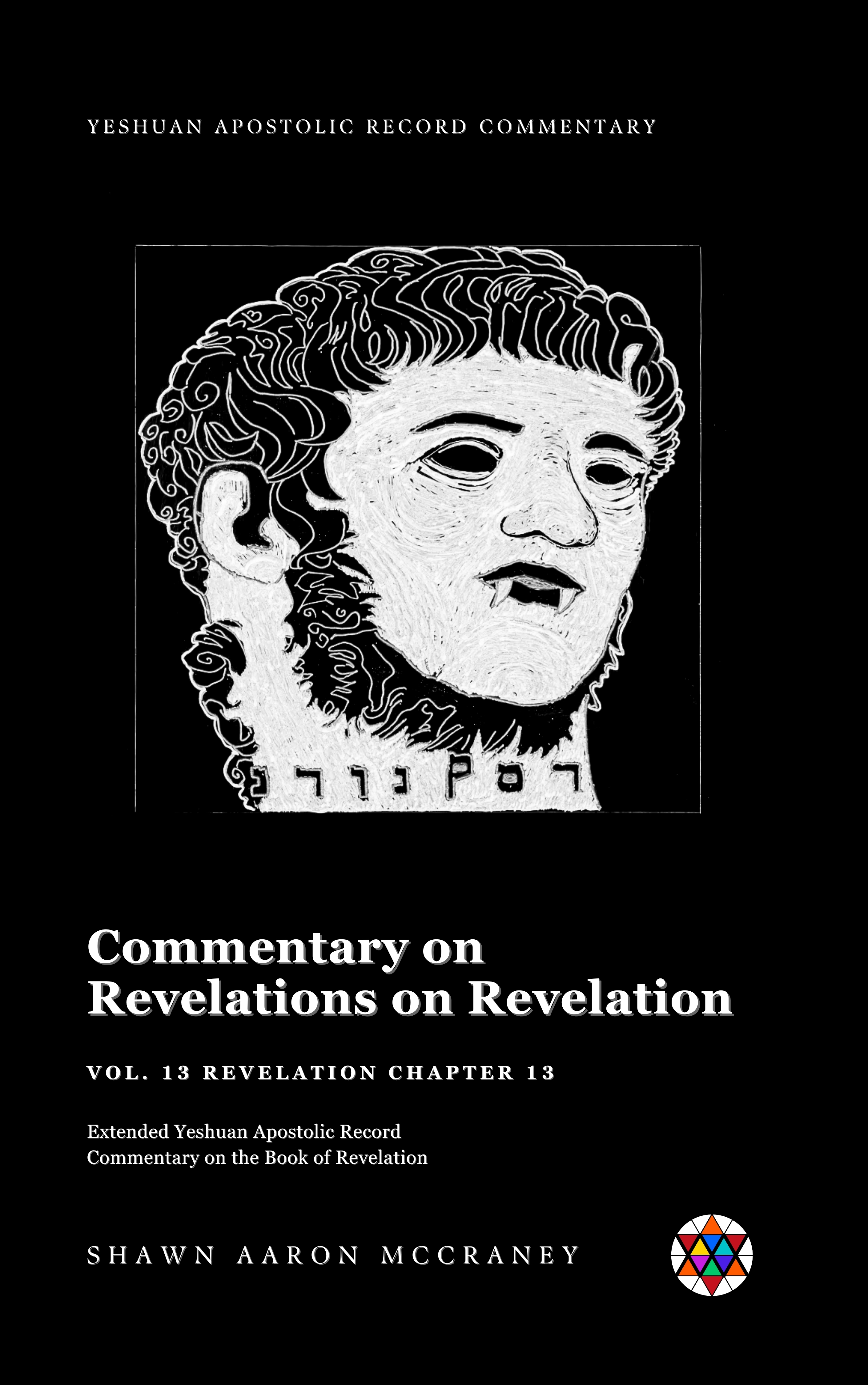
Revelation Chapter 13 Commentary
Expanded Yeshuan Apostolic Record Commentary on the Book of Revelation
This 22-volume collection offers a chapter by chapter expanded commentary on the book "Revelations on Revelation" by Shawn McCraney. This collection is a part of the Yeshuan Apostolic Record Commentary Collection, offering extended insights and clarifications on the entire purpose and place of the Apostolic Record (typically referred to as the New Testament) from a fulfilled perspective. It includes significant facts from various translations, commentaries, and historical contexts, as it expands on the footnotes in Revelations on Revelation. Volume 13 covers Revelation chapter 13: the beast rising out of the sea, the second beast rising out of the earth, the mark of the beast, and the number 666. It works carefully through the chapter's symbolic language verse by verse and closes with a summary review.

Sample: Revelation 13:1-7
Like a large snowball that has rolled from the top to the bottom of a hill, there is a lot of surface area we need to cover here, especially due to the use of esoteric language, before we can examine the core. So let’s do the best thing we can do to comprehend the Revelation – read it!
Revelation 13:1 And I stood upon the sand of the sea, and saw a beast rise up out of the sea, having seven heads and ten horns, and upon his horns ten crowns, and upon his heads the name of blasphemy. 2 And the beast which I saw was like unto a leopard, and his feet were as the feet of a bear, and his mouth as the mouth of a lion: and the dragon gave him his power, and his seat, and great authority. 3 And I saw one of his heads as it were wounded to death; and his deadly wound was healed: and all the world wondered after the beast. 4 And they worshipped the dragon which gave power unto the beast: and they worshipped the beast, saying, Who is like unto the beast? who is able to make war with him? 5 And there was given unto him a mouth speaking great things and blasphemies; and power was given unto him to continue forty and two months. 6 And he opened his mouth in blasphemy against God, to blaspheme his name, and his tabernacle, and them that dwell in heaven. 7 And it was given unto him to make war with the saints, and to overcome them: and power was given him over all kindreds, and tongues, and nations. 8 And all that dwell upon the earth shall worship him, whose names are not written in the book of life of the Lamb slain from the foundation of the world. 9 If any man have an ear, let him hear. 10 He that leadeth into captivity shall go into captivity: he that killeth with the sword must be killed with the sword. Here is the patience and the faith of the saints. 11 And I beheld another beast coming up out of the earth; and he had two horns like a lamb, and he spake as a dragon. 12 And he exerciseth all the power of the first beast before him, and causeth the earth and them which dwell therein to worship the first beast, whose deadly wound was healed. 13 And he doeth great wonders, so that he maketh fire come down from heaven on the earth in the sight of men, 14 And deceiveth them that dwell on the earth by the means of those miracles which he had power to do in the sight of the beast; saying to them that dwell on the earth, that they should make an image to the beast, which had the wound by a sword, and did live. 15 And he had power to give life unto the image of the beast, that the image of the beast should both speak, and cause that as many as would not worship the image of the beast should be killed. 16 And he causeth all, both small and great, rich and poor, free and bond, to receive a mark in their right hand, or in their foreheads: 17 And that no man might buy or sell, save he that had the mark, or the name of the beast, or the number of his name. 18 Here is wisdom. Let him that hath understanding count the number of the beast: for it is the number of a man; and his number is six hundred threescore and six.
Okay, back to verse one where John says:
Revelation 13:1 And I stood upon the sand of the sea, and saw a beast rise up out of the sea, having seven heads and ten horns, and upon his horns ten crowns, and upon his heads the name of blasphemy.
We are introduced now to a beast which John describes as “rising out of the sea, with ten horns and seven heads, with ten crowns on its horns and blasphemous names on its heads.” In chapter 12 we read about red dragon that was cast down to earth and we know from verse 9 that this being represented Satan and that he also is described as having “seven heads and ten horns,” but that he had “seven crowns on his head” whereas this beast rising out of the sea has ten crowns on his ten horns.
Therefore we know that, with the sea representing gentile nations, that either Satan (or a creature inhabited or directed by Satan) was going to rise up and out of a Gentile nation and head for land – which would be Israel. This reference here is very likely a way of telling the first century reader that this “beast” would be a prominent Gentile figure who, looking to Daniel 7:3, is similar to when he saw four great beasts coming “up out of the sea.” We will be told more about this beast, here in chapter 13 and also in chapter 17, including details about its 10 horns and seven heads which we will cover momentarily.
It’s important to realize something about this beast that trips people up in the study of Revelation. It has two natures – or is described in two ways which tends to confuse people. What I mean by this is the beast is described as an individual and it is described as being seven headed. With Israel being the land, and the gentiles being the sea, and with the singular plural beast coming out of the sea, to me it seems pretty clear – especially in context of all the other information we have discussed – that this singular beast is Rome (coming in to attack Israel - land) and that its seven heads represent its seven Caesars.
In some places (Revelation 13:1 and 17:3 and verses 9-10) the Beast has seven-heads where the seven kings are collectively considered. Here the beast then is generically portrayed as a “kingdom with seven kings that arise in chronological succession” (and Revelation 17:10-11 helps to illustrate this). But then again in the very same context the Beast is spoken of as an individual (Revelation 13:18) and more confusingly, as but one head among the seven (Revelation 17:11). Bottom line, the beast in Revelation is sometimes spoken of as an individual (specific sense) and sometimes as a kingdom (generic sense). It’s not surprising then that the beast is interchangeably an individual and a kingdom, if ancient Rome is in view here.
Ken Gentry, noted Preterist notes that even the Roman poet Ovid (43 BC-18AD) once described the emperor Augustus as, “The state is Caesar.” In order to really understand what the seven heads of the beast are, we are required to go to chapter 17:9-10 as John explains it to us there, saying:
9 And here is the mind which hath wisdom. The seven heads are seven mountains, on which the woman sitteth. 10 And there are seven kings: five are fallen, and one is, and the other is not yet come; and when he cometh, he must continue a short space.
So again, “the seven heads are seven mountains on which the woman is seated;” and then there “are also seven kings,” (which I would presume represent the seven mountains) “five of whom have fallen, one is, the other has not yet come, and when he does come he must remain only a little while.”
This description of the seven kings lines up well with historical data showing the emperors who reigned in the Roman Empire up until the destruction of the temple in 70 AD, which is as follows:
Order Name Emperor Length of Reign Notes/Details
#1 Julius Caesar October 49 BC – March 44 BC “Perpetual Dictator”
#2 Augustus January 27 BC – August 14 AD -time of Jesus’ birth
#3 Tiberius August 14 AD – March 37 AD -time of Jesus’ ascension
#4 Caligula March 37 AD – January 41 AD Murdered
#5 Claudius January 41 AD – October 54 AD Assassinated
#6 Nero October 54 AD – June 68 AD Committed suicide
#7 Galba June 68 AD – January 69 AD Murdered
#8 Otho January 69 AD – April 69 AD Committed suicide
#9 Vitellius April 69 AD – December 69AD Murdered
#10 Vespasian December 69 AD – June 79 AD Destroyed Jerusalem
As a means to refute this view, futurist may say that some historians do not consider Julius Caesar to be one of the emperors, and rather designate him as one who played a key role in transforming the Roman Republic into the Roman Empire. Flavius Josephus (37-100 AD), however, was one who did, and the above list reflects his own list that is included in his writing titled, Antiquities of the Jews (Books 18 and 19). Numerous Roman historian’s contemporary to Josephus agree. Among these were Dio Cassius and Suetonius (70-135 AD), who wrote “Lives of the Twelve Caesars” and “De Vita Caesarum.” Julius Caesar was appointed as “perpetual dictator” in 42 BC, so his inclusion in such a list would not have been strange. According to the above list, then, Nero was the “king” of whom John said in Revelation 17 “one is” (i.e. “he is reigning now”), and Galba was the one who had “not yet come.” Galba reigned only six months, making him a good candidate to be the one who “must remain only a little while.” The chart above indicates (in grayscale) that there were more Roman emperors than were referenced by John. Why does John only mention seven? One reason might be because the number seven is the reigning symbolic number of the book. Secondly, perhaps these seven cover the ground which the writer means to specifically occupy, meaning he writes only of the Kings through the period when the persecution would begin and end. And we know that the imperial persecution initiated by Nero ceased with his death in 68 AD. If we can accept that Revelation was written prior to that time, then “the enumeration of the kings” covers all of imperial history up until John’s time and the events that were “shortly’ to follow.”
Regarding the reference to seven mountains, there should be no doubt that this is speaking of Rome. Even the majority of futurist’s concede this point (although they may anticipate a revival of the Roman Empire in some fashion). We might also note that Coins of Vespasian (emperor of Rome from 69-79 AD) that have been discovered by archaeologists illustrate the goddess Roma as a woman seated on seven hills. Remember, Rome, the capital of the Roman Empire, is the one city in history that is famous for its seven mountains. In fact, first-century Rome used to celebrate a feast called Septimontium, the feast of “the seven-hilled city.”
Bringing this home to roost, it’s really pretty clear that Israel was being obliterated by Rome and this is what most of Revelation is describing. So, verse one again:
Revelation 13:1 And I stood upon the sand of the sea, and saw a beast rise up out of the sea, having seven heads and ten horns, and upon his horns ten crowns, and upon his heads the name of blasphemy.
Turning to Revelation 17:12-13 we read:
Revelation 17:12 And the ten horns which thou sawest are ten kings, which have received no kingdom as yet; but receive power as kings one hour with the beast. 13 These have one mind, and shall give their power and strength unto the beast.
Who are these who are of “one mind and who hand over their power and authority to the beast.” Some have thought these ten kings to be the very ones listed in the chart above, since all 10 of them reigned (or had begun to reign, in Vespasian’s case) before Jerusalem’s destruction. However, John wrote that in his day they had “not yet received royal power,” so this view is eliminated. Another more likely view is that these ten kings were the rulers of the ten empirical provinces of Rome who were empowered by Nero to assist him in carrying out his campaign of persecution against the saints, which Scripture refers to as “war on the Lamb” (in Revelation 17:14). The Global Glossary on the Greco-Roman world says there were 10 Senatorial Provinces in ancient Rome: They were
“areas that were governed by Roman pro-magistrates; there were ten senatorial provinces, eight of which were led by ex-praetors and two of which were led by ex-consuls.”
Wikipedia lists these 10 Senatorial Provinces, as they existed in 14 AD, as follows:
[1] Achaea [2] Africa [3] Asia [4] Creta et Cyrene [5] Cyprus [6] Gallia Narbonensis [7] Hispania Baetica [8] Macedonia [9] Pontus et Bithynia [10] Sicilia.
One biblical mention of a Roman provincial ruler is in Acts 18:12-17, where we are told of Gallio the “proconsul of Achaia.” In our verse by verse study of Acts, Paul and Barnabas, in Cyprus, had direct contact with the proconsul, Sergius Paulus (which is mentioned in Acts 13:7).
As a side note, there is really no way that the futurist supposition that “the beast will be a revived Roman empire,” today can occur because it can’t correspond with the modern European Union. We can see how this is impossible since the borders of the EU are very different from the boundaries of the old Roman empire. In other words, the ancient Roman Empire was vast and spread from Britain in the north to south of Egypt, from Spain and North Africa in the west to the borders of Parthia (Iran today) in the east. In the 1st century, when the New Testament was written, the border of the Roman Empire in Europe stopped at the Rhine and Danube Rivers. It never included any significant portion of Germany or Eastern Europe and the center of the Roman Empire was never Gaul (which is our France today). The heart of the Roman Empire in the 1st century were the great cities of Rome itself, Alexandria in Egypt, and the great Greek cities, with the great cities of Antioch, Damascus, and Jerusalem that were inland from the Mediterranean coast. The reunification of these boundaries in modern times are highly unlikely.
2 And the beast which I saw (coming out of the Gentile nation) was like unto a leopard, and his feet were as the feet of a bear, and his mouth as the mouth of a lion: and the dragon gave him his power, and his seat, and great authority.
Where is all of this coming from? Interestingly enough, the beast is now being described in such a way that it incorporates the traits of all four beasts that Daniel saw in a vision in his day – which we read about in Daniel 7:1-8.
1 In the first year of Belshazzar king of Babylon Daniel had a dream and visions of his head upon his bed: then he wrote the dream, and told the sum of the matters. 2 Daniel spake and said, “I saw in my vision by night, and, behold, the four winds of the heaven strove upon the great sea. 3 And four great beasts came up from the sea, diverse one from another. 4 The first was like a lion, and had eagle's wings: I beheld till the wings thereof were plucked, and it was lifted up from the earth, and made stand upon the feet as a man, and a man's heart was given to it. 5 And behold another beast, a second, like to a bear, and it raised up itself on one side, and it had three ribs in the mouth of it between the teeth of it: and they said thus unto it, Arise, devour much flesh. 6 After this I beheld, and lo another, like a leopard, which had upon the back of it four wings of a fowl; the beast had also four heads; and dominion was given to it. 7 After this I saw in the night visions, and behold a fourth beast, dreadful and terrible, and strong exceedingly; and it had great iron teeth: it devoured and brake in pieces, and stamped the residue with the feet of it: and it was diverse from all the beasts that were before it; and it had ten horns. 8 I considered the horns, and, behold, there came up among them another little horn, before whom there were three of the first horns plucked up by the roots: and, behold, in this horn were eyes like the eyes of man, and a mouth speaking great things.
Generally speaking, Bible scholars seem to be in partial, if not full agreement, that the beasts in Daniel’s vision represented
- the Babylonian,
- Medo-Persian,
- Greek,
- and Roman empires.
It’s interesting that when Paul was released from prison (from under the hand of Nero) that he says in 2nd Timothy 4:17
“I was delivered out of the mouth of the lion”
Rome appears to have been brought into the picture as a chief agent of the judgment that came upon Jerusalem in 70 AD. It (Rome) was the persecuting power that was the hand of the Old Serpent cast to earth to persecute the Saints of God.
3 And I saw one of his heads as it were wounded to death; and his deadly wound was healed: and all the world wondered after the beast. 4 And they worshipped the dragon which gave power unto the beast: and they worshipped the beast, saying, “Who is like unto the beast? who is able to make war with him?”
At verse 3, John says that one of the beast’s seven heads had what appears to be a mortal wound. But then in the next line it is healed, and the world wondered (or had wonder). First of all, this was not the world here (meaning, not kosmos) but describes the region, area or land). This brings in some clarity. I have long had this beast described to me as an actual creature or individual who will receive this wound but if we step back into reasonable context and see it as “Roman Rule at large” we can better understand the contents of what we are reading from a historical setting. Perhaps the best theories regarding this “mortally wounded head” is that it refers to the survival of the Roman Empire after the stunning deaths of either Julius Caesar or Nero. Even if Nero himself was mortally wounded in the head, it is not he who personally survives the wound but the beast that survives the wounding of one of its heads. Here’s the key: we know that at the death of Nero, the Roman Empire was thrown into violent convulsions of civil war and anarchy, in which three emperors succeeded one another within a single year. Historians consider it astonishing that the empire stabilized and survived this period that could have easily have spelled the end of the imperial rule. Therefore, the recovery of the empire under Vespasian was a genuine marvel to all, and this is what John is depicting here, the Empire had survived the mortal wounding of one of its heads (Nero) and yet revived.
We might be surprised that a number of Futurist writers agree with this interpretation and even attribute this passage to the “terrible convulsions which in 69 A.D. shook the (Roman) empire to its foundation.” One noted futurist in particular (Walvoord) believes that the “wounding of one of the heads was a reference to the fact that the Roman Empire seemingly died but will (in the future) be revived.”
Is it a surprise that the Jews (“the whole earth” or the people of that area in verse 3) would worship the beast? Is there any indication in scripture of their willingness to do this? We do have one fairly clear example. When Jesus was brought before the leaders and mob by Pilate and they had a chance to receive Him as their King their reply was what?
“We have no king but Caesar!”
Jewish scholar who converted to Christianity, Alfred Edersheim writes:
“With this cry Judaism was, in the person of its representatives, guilty of denial of God, of blasphemy, of apostasy. It was here that it committed suicide.”
We also note that in this scriptural example that the rulers of Rome were not only called “emperors,” but “kings” which helps bring further light to the text of Revelation 17:10, where the seven “kings” can easily be understood as Roman emperors.
Here in Revelation 13:4, we see not only the Jews’ adoration of Rome’s incomparable power and stamina (when they say things like, “Who is like the beast…?”), but we also sense their sense of being powerless to oppose Rome in any way (“and who can fight against it?”). So, maintaining that this beast was Rome, we can now read verses 5-7:
5 And there was given unto him a mouth speaking great things and blasphemies; and power was given unto him to continue forty and two months. 6 And he opened his mouth in blasphemy against God, to blaspheme his name, and his tabernacle, and them that dwell in heaven. 7 And it was given unto him to make war with the saints, and to overcome them: and power was given him over all kindreds, and tongues, and nations.
Okay, so there was given the beast, who John told us has a mouth like a lion, which
- spoke “haughty and blasphemous words.”
- and power was given unto him to continue forty and two months.
- And he opened his mouth in blasphemy against God, to blaspheme his name, and his tabernacle, and them that dwell in heaven.
- And it was given unto him to make war with the saints,
- and to overcome them:
- and power was given him over all kindreds, and tongues, and nations.
Prior to Nero’s persecution, persecution against Christians had come largely from the Jews. Christianity was considered a sect of Judaism, which was a “legal religion” as evidenced by the fact that Paul appealed to Nero Caesar (in Acts 25:11-12; 28:19) but in 62 AD had been acquitted and released. Some scholars suggest that Rome didn’t even make a clear distinction between Christianity and Judaism until 64 AD and this is supported by the testimonies of early historians when they wrote about Nero’s campaign of persecution against Christians. For example, Eusebius (260-340 AD) pointed out that Nero was “the first of the emperors who showed himself an enemy of the divine religion,” and Lactantius (240-320 AD) agrees by saying of Nero, “He it was who first persecuted the saints of God.” Sulpicius Severus (360-420 AD) said that he was “the basest of all men, and even of wild beasts, [showing himself] in every way most abominable and cruel…he first attempted to abolish the name of Christian.” Sulpicius devoted two chapters to Nero’s reign of terror in his Sacred History, and listen, by comparison, he only gives three sentences to Domitian – who was also horrible to the Saints.
In 1854 church historian John Laurence von Mosheim added these thoughts:
“Foremost in the rank of those emperors, on whom the church looks back with horror as her persecutors, stands Nero, a prince whose conduct towards the Christians admits of no palliation [minimizing], but was to the last degree unprincipled and inhuman. The dreadful persecution which took place by order of this tyrant, commenced at Rome about the middle of November, in the year of our Lord 64. This dreadful state of persecution ceased with the death of Nero. The empire, it is well known, was not delivered from the tyranny of this monster until A.D. 68, when he put an end to his own life.”
If we take note of these dates we find the time allotted to pretty much fit. Tacitus, the Roman historian who lived from 56-117 AD, wrote in detail of Nero’s move to persecute the saints soon after the fire that raged through Rome, destroying 10 out of 14 city divisions – and he said:
“But by no human contrivance, whether lavish contributions of money or of offerings to appease the gods, could Nero rid himself of the ugly rumor that the fire was due to his orders. So to dispel the report, he substituted as the guilty persons and inflicted unheard-of punishments on those who, detested for their abominable crimes, were vulgarly called Christians…wrapped in the hides of wild beasts, they were torn to pieces by dogs, or fastened to crosses to be set on fire, that when the darkness fell they might be burned to illuminate the night.”
Now, the single most remarkable detail about Nero’s campaign of persecution is that it lasted just over 42 months, which Revelation 13:5-8 records as the length of time that would be given to the beast to “war against and conquer the saints.” This is some real history matching some real prophecy given at that time. And again, the persecution ended when Nero died on June 9, 68 AD. In this context, Revelation 13:10 was a comfort to the saints. Not only were they already told that the beast would only be allowed to persecute them for 3.5 years, but the Revelation here (at verse 10) also told how them their persecutor would be removed, saying:
“… he who kills with the sword must be killed with the sword. Here is the patience and faith of the saints.”
Nero ended his life by thrusting his sword through his own throat, with the help of his personal secretary, Epaphroditus, when he realized that his popularity had waned and that a coup was in the making.
So, back in chapter 12 we learned how the dragon (Satan) was allowed by God to “to make war on the saints and conquer them.” We also saw in chapter 12 how the dragon (Satan) became enraged with “the woman” and “went off to make war on the rest of her offspring” (12:17). This is clearly a reference to persecution of the Church, for “her offspring” are identified as “those who keep the commandments of God and hold to the testimony of Jesus.” At this point, the Jewish believers have escaped from Jerusalem (Revelation 12:13-16) but the believers in general throughout the Roman Empire are targeted for persecution and many are martyred. John records that authority is given to the beast, not just over Israel, but “over every tribe and people and language and nation.” In this way, Rome becomes the Devil’s agent.
History and tradition tells us of the persecutions of Rome; how Paul was beheaded, and Peter crucified upside down; how the Christians were thrown to the lions, exposed to the cold, drowned in rivers, thrown into cauldrons of boiling oil, daubed with pitch and burned for torchlights; how every conceivable torture was inflicted on them; and how all the might and power of the Roman empire were exerted to destroy them, till the church at length conquered its persecutor.
With regard to the forty-two month limit for the beast’s intense persecution of the Church, this was important information to the first century believer since many of them were about to face great persecution they would have been encouraged by the fact that though it would be severe, it would end, after forty-two months.
Numerous church fathers and leaders during the first several centuries identified Nero as the beast of the book of Revelation or at least speculated that it was him. These included Clement of Alexandria [150-215 AD], Tertullian [160-220 AD], Augustine [354-430 AD], and Jerome [347-420 AD] who stated the following in his commentary on Daniel 11:27-30:
“As for the Antichrist, there is no question but what he is going to fight against the holy covenant, and that when he first makes war against the king of Egypt, he shall straightway be frightened off by the assistance of the Romans. But these events were typically prefigured under Antiochus Epiphanes, so that this abominable king who persecuted God’s people foreshadows the Antichrist, who is to persecute the people of Christ. And so there are many of our viewpoint who think that Domitius Nero was the Antichrist because of his outstanding savagery and depravity.”
Others point to historical details from the reign of Nero to show how he fit the biblical description of the beast introduced here in Revelation 13 saying:
“The blasphemous worship demanded by the beast distinctly reminds one of the imperial cult of the first century, and the war the beast wages on the saints cannot help but recall the intense persecutions Nero, and later Domitian, inflicted on Christians because they did not worship Caesar. Nero’s persecution of Christians from November AD 64 [when he blamed the Christians for the massive fire he started] to June AD 68 could account, in part, for the forty-two months (or 3 ½ years) of oppression mentioned in Revelation 13:5. The reference in Revelation 13:11-15 to the beast of the land securing worship for the beast from the sea (Rome was across the sea from the place of the writing of the Apocalypse, Asia Minor) reminds one of the local priests of the imperial cult in Asia Minor whose task was to compel the people to offer a sacrifice to Caesar and proclaim him Lord. Megalomaniac that he was, Nero had coins minted in which he was called “almighty God” and “Savior.” Nero’s portrait also appears on coins as the god Apollo playing a lyre. While earlier emperors were proclaimed deities upon their deaths, Nero abandons all reserve and demanded divine honors while still alive (as did also Caligula before him, AD 37-41). Those who worshipped the emperor received a certificate or mark of approval – charagma, the same word used in Revelation 13:16 (the famed mark of the beast).