Revelation Chapter 8 Commentary
Expanded Yeshuan Apostolic Record Commentary on the Book of Revelation
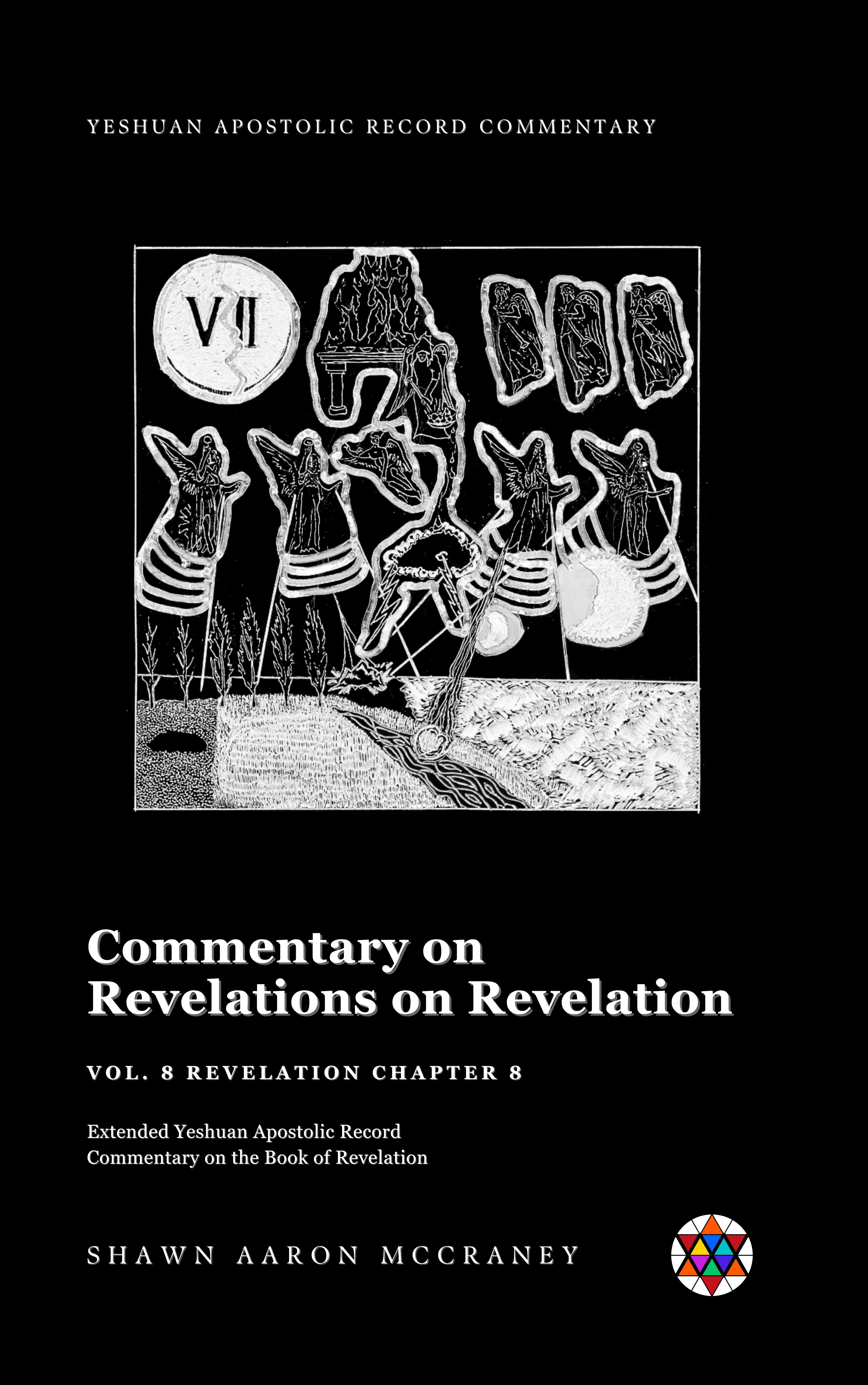
This 22-volume collection offers a chapter by chapter expanded commentary on the book "Revelations on Revelation" by Shawn McCraney. This collection is a part of the Yeshuan Apostolic Record Commentary Collection, offering extended insights and clarifications on the entire purpose and place of the Apostolic Record (typically referred to as the New Testament) from a fulfilled perspective. It includes significant facts from various translations, commentaries, and historical contexts, as it expands on the footnotes in Revelations on Revelation. Volume 8 covers Revelation chapter 8 and the first four trumpet judgments. It reads the chapter against the historical record of the Jewish War and the Roman destruction of Jerusalem, examines key Greek terms such as the word translated "earth," and surveys the history of Jerusalem from Alexander the Great through the Maccabees and Roman rule.

Sample: Revelation 8 Introduction
I must admit that chapter 8 and 9 were written in such a way as to cause tremendous consternation in my heart as I had no idea how to justify much of what was said in terms of fulfilled prophecy. I anticipated having to work through all of the four approaches to figure it out. But then I thought I would stand on my view and see if it first held water when looking at the historic record of the War of the Jews and the Roman destruction of Jerusalem. Here, I found some solace.
So, let’s work through some of the key words by checking the Greek in the chapter. In chapter 8, which describes the first four trumps when the text says that this and that happened to the earth, the earth is always translated GAHAY (and never Kosmos) so we know that it is talking about the land or the area and not the whole world. This is very important. As a result we therefore know that when the passages say that a third part of the land’s trees and rivers and oceans animals etc. were wiped out this gives us a very reasonable and doable picture of the destruction. So, there’s that.
Let’s also talk briefly about the wrapping up of Jerusalem for a minute. I am not going to cover how David made Jerusalem the seat to his Empire but am going to focus on the years of Alexander the Great.
When Alexander the Great conquered the Persian Empire, Jerusalem and Judea fell under Greek control and under a great Hellenistic influence. In 198 BC, as a result of the Battle of Panium, Ptolemy the 5th lost Jerusalem and Judea to the Seleucids under the direction of Antiochus the Great. During this time many Jews had become Hellenized and with their assistance tried to fully Hellenize Jerusalem. This led to a rebellion by the High Priest Matityahu ben Yoḥanan and his five sons who are also known as the “Makabi” or the Maccabees. As a result of the Maccabean revolt, Jerusalem became the capital of what was called the independent Hasmonean Kingdom which lasted for 103 years.
There is a whole story about how the Maccabeans ruled during this time but long story short there came a time when two rulers over the area asked for Rome to intervene on their respective parts, Judea fell under the greater rule of Rome as an autonomous province that maintained a significant amount of independence. Then in 37 BCE, Herod the Great captured Jerusalem after forty-day siege, ending Hasmonean rule all together.
Herod ruled the Province of Judea as what we might call a “client-king of the Romans,” and rebuilt the Second Temple, upgraded the surrounding complex, and expanded the minting of coins of many denominations. Pliny the Elder, a historian, writing of Herod's achievements, called Jerusalem "the most famous by far of the Eastern cities and not only the cities of Judea." The Talmud comments that "He who has not seen the Temple of Herod has never seen a beautiful building in his life." Roman historian Tacitus wrote that "Jerusalem is the capital of the Jews. In it was a Temple possessing enormous riches." Herod also built Caesarea which replaced Jerusalem as the capital of the Roman province.
In 6 AD, following Herod's death in 4 BC, Judea and the city of Jerusalem came under direct Roman rule through Roman prefects, procurators, and rulers. Nevertheless, Herod's descendants remained nominal kings of Idumea Province. This brings us to the beginning of the end of the place as the first Jewish revolt.
Now remember, when Jesus was on the Mount of Olives and was describing what the end of the age would look like He provided signs. These signs increased in intensity and led to the ultimate destruction of all that that age was about. Well, the destruction began because of the Jews. In 66 AD, the Jewish population rebelled against the Roman Empire in what is now known as the First Jewish–Roman War or the “Great Revolt.” The Great Revolt originated because of Roman and Jewish ethnic tensions. It escalated due to anti-taxation protests and then outright attacks upon Roman citizens. In response, the Roman governor, Gessius Florus, plundered the Jewish Temple, claiming the money was for the Emperor, and then the very next day launched a raid on the city, arresting numerous senior Jewish figures. This prompted a wider, large-scale rebellion by the Jews and the Roman military garrison of Judaea was quickly overrun by the rebels, while the pro-Roman king Agrippa II, together with Roman officials, fled Jerusalem. When it was clear that the rebellion was getting out of control, Cestius Gallus, the legate of Syria, brought in the Syrian army, based on Legion XII Fulminata, and reinforced by auxiliary troops, to restore order and quell the revolt. This response fulfills parts of what Jesus described in Matthew 24.
However, in spite some initial advances and conquest of Jaffa, the Syrian Legion was ambushed and defeated by Jewish rebels at the Battle of Beth Horon with 6,000 Romans massacred. During 66 AD the Judean Free Government was formed in Jerusalem and High Priest Ananus ben Ananus began reinforcing the city, with Yosef Ben Gurion as another prominent leader in charge. Yosef ben Matityahu was appointed the rebel commander in Galilee and Elazar ben Hananiya as the commander in Edom. Later, in Jerusalem, an attempt by Menahem ben Yehuda, leader of the Sicarii, to take control of the city failed and he was executed and the remaining Sicarii were ejected from the city.
Then Simon bar Giora, a charismatic, but radical peasant leader, was also expelled by the new government called the Judean Free Government.
At this point Vespasian, an experienced and unassuming general, was given the task of crushing the rebellion in the Judea province. He had a son named Titus who was appointed as second-in-command. Given four legions and assisted by forces of King Agrippa II, Vespasian invaded Galilee in 67 AD.
Avoiding a direct attack on the reinforced city of Jerusalem, which was defended by the main rebel force, the Romans launched a persistent campaign to eradicate rebel strongholds and punish the population. Within several months Vespasian and Titus took over the major Jewish strongholds of Galilee and finally overran Jotapata, which was under the command of Yosef ben Matityahu. Driven from Galilee, Zealot rebels and thousands of refugees arrived in Jerusalem, creating political turmoil. Confrontation between the mainly Sadducee Jerusalemites and Zealot factions the area erupted into bloody violence. With Idumeans entering the city and fighting by the side of the Zealots, the former high priest, Ananus ben Ananus, was killed and his faction suffered severe casualties.
Simon Bar Giora, commanding 15,000 militiamen, was then invited into Jerusalem by the Sadducee leaders to stand against the Zealots, and quickly took control over much of the city. Bitter infighting between factions lasted through the year 69 AD. After a lull in the military operations, owing to civil war and political turmoil in Rome, Vespasian was called to Rome and appointed as Emperor in 69 AD. With Vespasian's departure, Titus moved to besiege the center of rebel resistance in Jerusalem in early 70.
The first two walls of Jerusalem were breached within three weeks, but a stubborn rebel standoff prevented the Roman Army from breaking the third and thickest wall. Following a brutal seven-month siege, during which Zealot infighting resulted in burning of the entire food supplies of the city, the Romans finally succeeded in breaching the defenses of the weakened Jewish forces in the summer of 70 AD. This introduced the beginning of the end of that age – of which we are given a description here in Revelation 8.
In the 2nd Century, one Hadrian began to rebuild Jerusalem as a pagan city (and what today is known as the Old City). He renamed it “Aelia Capitolina” in 135 AD. We’ll stop there on the history of the place.
In accordance with the contents of Revelation 8, the Roman Assault on Jerusalem begins around the Feast of Trumpets and therefore we have the Seven Trumpets of Revelation—aka, the beginning of the Jewish War. So let’s read our text at this point, remembering that Chapter 6 introduced six of the Seven Seals, and Chapter 7 describes a period of peace and heavenly gathering around the throne, and now chapter 8 brings us back to the opening of the Seventh Seal.
Revelation 8:1 And when he had opened the seventh seal, there was silence in heaven about the space of half an hour. 2 And I saw the seven angels which stood before God; and to them were given seven trumpets. 3 And another angel came and stood at the altar, having a golden censer; and there was given unto him much incense, that he should offer it with the prayers of all saints upon the golden altar which was before the throne. 4 And the smoke of the incense, which came with the prayers of the saints, ascended up before God out of the angel's hand. 5 And the angel took the censer, and filled it with fire of the altar, and cast it into the earth: and there were voices, and thunderings, and lightnings, and an earthquake. 6 And the seven angels which had the seven trumpets prepared themselves to sound. 7 The first angel sounded, and there followed hail and fire mingled with blood, and they were cast upon the earth: and the third part of trees was burnt up, and all green grass was burnt up. 8 And the second angel sounded, and as it were a great mountain burning with fire was cast into the sea: and the third part of the sea became blood; 9 And the third part of the creatures which were in the sea, and had life, died; and the third part of the ships were destroyed. 10 And the third angel sounded, and there fell a great star from heaven, burning as it were a lamp, and it fell upon the third part of the rivers, and upon the fountains of waters; 11 And the name of the star is called Wormwood: and the third part of the waters became wormwood; and many men died of the waters, because they were made bitter. 12 And the fourth angel sounded, and the third part of the sun was smitten, and the third part of the moon, and the third part of the stars; so as the third part of them was darkened, and the day shone not for a third part of it, and the night likewise. 13 And I beheld, and heard an angel flying through the midst of heaven, saying with a loud voice, Woe, woe, woe, to the inhabiters of the earth by reason of the other voices of the trumpet of the three angels, which are yet to sound!
So, let’s start by tying some of this verbiage in Revelation 8 with the historical record of the Jewish Roman war. In A.D. 66, while Judea was aflame in bloodshed, riot and revolt, Rome sent in their 12th legion in addition to thousands of auxiliaries from neighboring kingdoms. These troops, as if orchestrated by God, arrived in Jerusalem in the Jewish month of Tishri, a month that not by chance, begins with the Feast of Trumpets, which marked the beginning of ten days of consecration and repentance before God. The Feasts of Trumpets is one of seven Jewish feasts or festivals appointed by the LORD and one of three feasts that occur in the autumn. It began on the first day (at the new moon) of the seventh month and its name comes from the command to blow trumpets (Leviticus 23:24; Numbers 29:1-6). It is also called Rosh Hashanah, which means “Head of the Year,” because it marks the beginning of the Jewish civil calendar.
During this celebration, no kind of work was to be performed, but burnt offerings and a sin offering were to be brought before the Lord. In Leviticus, the words trumpet blasts are a translation of the Hebrew word teruah, which means “a shout” or “a blowing.” It appears that the shofar (ram’s horn) was to be blown at this time, as it was on the other new moons (Psalm 81:3). Jewish tradition indicates that both the ram’s horn and the priestly silver horns (hazozerah) were used in the Feast of Trumpets.
Now this was an important feast for several reasons.
First, it commemorated the end of the agricultural and festival year. Remember Jesus saying that “great is the harvest but the laborers are few?” This is so perfectly consistent with the reaching to the House of Israel with the Good News and the end of that harvest all together. Also, the Day of Atonement fell on the tenth day of this month, and the Festival of Booths began on the fifteenth day. The blowing of the trumpets on first day of the month heralded a solemn time of preparation for the Day of Atonement; this preparation time was called “Ten Days of Repentance” or the “Days of Awe.” The trumpet sound was an alarm of sorts and can be understood as a call to introspection and repentance. The Feast of Trumpets, along with the other six festivals of the LORD, foreshadowed certain aspects of the ministry of Jesus Christ. The prophets linked the blowing of trumpets to the future Day of Judgment:
“Blow the trumpet in Zion; sound the alarm on my holy hill. Let all who live in the land tremble, for the day of the LORD is coming. It is close at hand” (Joel 2:1 and alsoZephaniah 1:14, 16).
In the New Testament, we see that the Lord’s Second Coming will be accompanied by the sound of a trumpet. Remember that 1st Corinthians 15 Paul is talking all about the Resurrection. And after doing so he says something really interesting to his audience then and there. What does he say? He says
1 Corinthians 15:51 “Behold, I shew you a mystery; We shall not all sleep, but we shall all be changed, 52 In a moment, in the twinkling of an eye, at the last trump: for the trumpet shall sound, and the dead shall be raised incorruptible, and we shall be changed.”
I emphatically reassert that Paul was writing to believers then and there, and that for this epistle to be true then what he said (in verses 51-52) had to have happened then or else the “mystery” Paul showed them was a lie, and he was wrong, making everything he said suspect. But Paul wasn’t wrong. The mystery that he said he would show them, which was that “We would not all sleep but we would all be changed” happened. And the only way it could and would have happened then would have been if Jesus had returned to them as He, and the other apostles, had as promised. Therefore, we know that the contents of the Seven trumpets – and all that they describe - have direct application to that day and age and not to ours.
Adding direct fuel to that fire Paul wrote in 1st Thessalonians 4:13-18 something similar and if what he wrote in that epistle was not realized then Paul was wrong. But he wasn’t wrong in what he said, which was:
13 But I would not have you to be ignorant, brethren, concerning them which are asleep (dead), that ye sorrow not, even as others which have no hope. 14 For if we believe that Jesus died and rose again, even so them also which sleep in Jesus will God bring with him. 15 For this we say unto you by the word of the Lord, that wewhich are alive and remain unto the coming of the Lord shall not prevent them which are asleep. (for Paul to write this implies the fact that some would be alive unto the coming of the Lord – or, again, Paul would have been wrong. Then he adds) 16 For the Lord himself shall descend from heaven with a shout, with the voice of the archangel, and with the trump of God: and the dead in Christ shall rise first: 17 Then we which are alive and remain shall be caught up together with them in the clouds, to meet the Lord in the air: and so shall we ever be with the Lord. 18 Wherefore comfort one another with these words.”
Each of the judgments in Revelation chapters 8-9 are signaled by a trumpet. Just as the “shofar” called the Jewish nation to turn their attention to the Lord and ready themselves for the Day of Atonement, so will the “trump of God” call all to heaven (as it were) and warn the land of coming judgment (described here in Revelation). Remember, this was called “the Day of Judgment,” in ancient Israel and it is on this day that trumpets sound the days of atonement and final judgment according to Leviticus 23:24 and Numbers 29:1.
It is really important to know that trumpets were used by both the Ancient Jewish world, the modern Jewish world of that day, and the Roman military in order to sound an attack and rally troops for war. In fact, all seven of the “plagues” that we are going to read about were announced by a literal, audible trumpet sound. Therefore, the symbolic use of trumpets here in Revelation 8 were literal in that an actual trumpet blast marked the start of several notable battles, with the last war itself beginning on the Feast of Trumpets.
Hard to get more on the nose than this when it comes to interpretation.