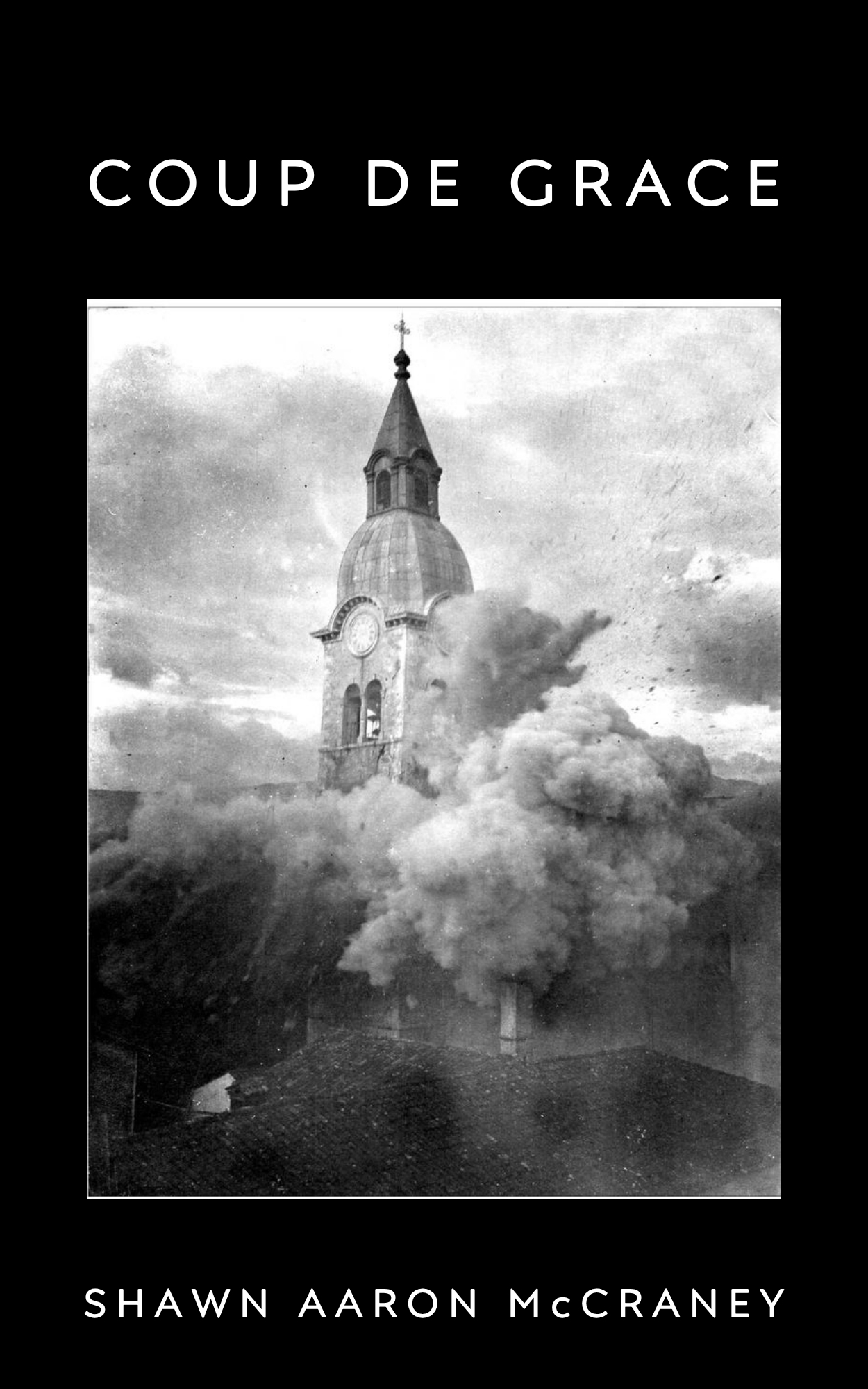
Coup De Grace
"Coup de Grace: God’s Merciful End of Brick and Mortar Religion" by Shawn McCraney is a short and concise articulation of the trouble with institutional religion, and the simple solution that subjective faith offers. Arguing for a return to a personal connection with God, free from outdated traditions and structures, McCraney critiques the historical and scriptural legitimacy of organized religion, encouraging individuals to reclaim their personal and autonomous relationship with God.

Sample: The Problem
And they said to one another, “Go to, let us make brick, and burn them hard. And they had brick for stone, and slime had they for mortar. And they said, Go to, let us build us a city and a tower, whose top may reach unto heaven; and let us make us a name, lest we be scattered abroad upon the face of the whole earth.
Genesis 11:3-4
One of the foundational claims threaded through almost every material expression of Christianity today is the idea that Jesus, while incarnate, established a Church and that there is a need today, even a divine commission, for human beings to ensure its continued material existence until He returns to take it.
From the high church of Roman Catholicism, Orthodoxies, Episcopalian’s and Anglicans to every Protestant denomination large or small (with Lutherans in-between), all denominations at least tacitly suggest by their very existence that they best represent the Church Jesus established and that they follow the principles of His original church better than any other. Nowhere
is this attitude more apparent and emphasized than in the Church of Jesus Christ of Latter-Day Saints, which single-handedly claims to be, “The Restored Church,” that singularly possesses, “The Restored Gospel.” Emphasis twice on the article, “The.” Broken down, the name of this world-wide religious empire truly says it all
The Church (a brick and mortar institution)
of Jesus Christ (boldly removing any doubt that it is His) of Latter-Day (directly stating that it exists in the last centuries of the world’s existence)
Saints (an overt nod that its members are collectively and truly sanctified disciples of the Lord Jesus Christ).
Built-in to the claim of being Jesus’ original church today is not only the belief that He promised to return and collect His faithful Bride but that until He does His church would comport itself in all the ways He originally established.
From a biblical perspective (specifically from what people mistakenly call the New Testament, 1) this makes great sense as Jesus certainly spoke of Him having a church and He made it plain that it would not fail 2 and that He would return to take her. 3 Even a casual reader of the Apostolic Record can see that His nascent church operated on clearly established practices and principles, including missional outreach, supernaturally empowered apostles who directly governed the collective, an abundance of spiritual gifts evidencing the power of the Spirit at work, the calling of deacons and elders to oversee believers at the local level and other more subtle directives which help define Jesus’ church as a place of discipline and order. Most sobering, however, are the words of the Apostle Paul (which are often overlooked today by Evangelicals) who makes it plain that this church didn’t only need to unitedly function 4 but that it had to holy, even spotless. 5 Speaking of the church at Ephesus Paul said “That he (Jesus) might present it to himself a glorious church, not having spot, or wrinkle, or any such thing; but that it should be holy and without blemish.” (Ephesians 5:27)
If Jesus’ Church exists today, as the majority of Christians
maintain, we would expect that it would meet all the biblical descriptions that originally defined it, including that of holiness so extreme that it collectively existed “without blemish.” In addition to the gathering of unified believers being “spotless,” and a church that Jesus said “the gates of hell would not prevail against,” John the Revelator said that there would be 144,000 men of it who were so dedicated to Jesus that they would be “virgins,” having not “defiled themselves with women.” 6 Post ascension Jesus was uncharacteristically stern to the believers in the actual churches of Asia minor when He repeatedly warned them to “repent” and to “overcome” or they would not be acceptable at His promised coming. 7 Add in all of the Apostolic directives to the church of that age and we can readily see that Jesus certainly did establish a church, that it was to be governed by living apostles that kept it united and pure, and that the believers of that day had better conform to everything that Jesus and His apostles said or they would not be saved at His promised return to take them. In the face of these things, a modern seeker of Christian truth is moved to ask:
“Has any brick and mortar institution remained consistently true to the biblical model of the original church and all the expectations placed upon it?”
“Has any formal brick and mortar attempts from the past to the present escaped being blemished, spotted, and impure?”
“Has any religious institution refrained from adding to the established textual directives of how His church should operate?”
To the last query, it is one thing for a religious institution to claim to follow every canonized word of scripture in their material formation and history but it is an altogether different matter when extra-biblical practices and teachings enter in and blemish the purity of the Bride with things like infant baptism, Mariology, incense burning, a resurgence of temple rites, iconography, the observance of special days, the honoring of selected saints, the office of stake presidents or forbidding to accept African American priests?
And then what about the low material footprint in the early church
that Jesus and His apostles established along with all the teachings against luxry, mammon and riches? What are we to day when material churches today erecting billion-dollar empires of luxury when the very Son of Man had no place to rest His head? Where do we ever find a mandate in the Apostolic Record where
followers of Christ unitedly or even individually engage in political warfare or march in the streets against social ills when Jesus plainly told Pilate that His “Kingdom is not of this world because if it was His servants would fight?" 8 Nowhere do we read of either Jesus or his apostles raising a finger against the imperialistic laws and practices of Rome which in some ways were far more barbaric and pagan than what we find in the civilized world today? 9
Is it possible that for nearly 2000 years, Christians of every expression have overlooked or ignored God’s established solution to these errancies and have pursued a course similar to those in the days of Babel and building cities? What clues do we have that this is exactly the case and there is a need for a complete overhaul of brick and mortar religion today as a means to be what God intended for His children?
- God Himself describes His New Testament in a very different way than as a collection of books gathered into a canonized body when He said in Jeremiah 31:31-34, “Behold, the days come, saith the LORD, that I will make a new covenant with the house of Israel, and with the house of Judah: Not according to the covenant that I made with their fathers in the day that I took them by the hand to bring them out of the land of Egypt; which my covenant they brake, although I was an husband unto them, saith the LORD: But this shall be the covenant that I will make with the house of Israel; After those days, saith the LORD, I will put my law in their inward parts, and write it in their hearts; and will be their God, and they shall be my people.” From this point forward I will refer to the New Testament as the Apostolic Record. ↩
- Matthew 16:18 “And I say also unto thee, that thou art Peter, and upon this rock I will build my church; and the gates of hell shall not prevail against it.” ↩
- Matthew 24; 1st Thessalonians 4:15-17; Revelation 2:25; 3:3, 11; 22:7,12,20 ↩
- Ephesians 4:5; Philippians 1:27 ↩
- Ephesians 5:3 But fornication, and all uncleanness, or covetousness, let it not be once named among you, as becometh saints; 4 Neither filthiness, nor foolish talking, nor jesting, which are not convenient: but rather giving of thanks. 5 For this ye know, that no whoremonger, nor unclean person, nor covetous man, who is an idolater, hath any inheritance in the kingdom of Christ and of God. 6 Let no man deceive you with vain words: for because of these things cometh the wrath of God upon the children of disobedience. ↩
- Revelation 14:3-4 ↩
- Revelation 2:5,16-17,21-26; 3:3,5,12,19,21 ↩
- John 18:36 Jesus answered, my kingdom is not of this world: if my kingdom were of this world, then would my servants fight, that I should not be delivered to the Jews: but now is my kingdom not from here. ↩
- According to Matthew Rueger in his book, Sexual Morality in a Christless World, sexual relations in the ancient Rome, including in Christ's day, was "all about male dominance," and openly allowed for males to dominate women, boys and other males even if married. Man-boy love was fully embraced as was prostitution, promiscuity of any kind in addition to complete inequality between the sexual practices of married men compared to their subjugated wives. ↩