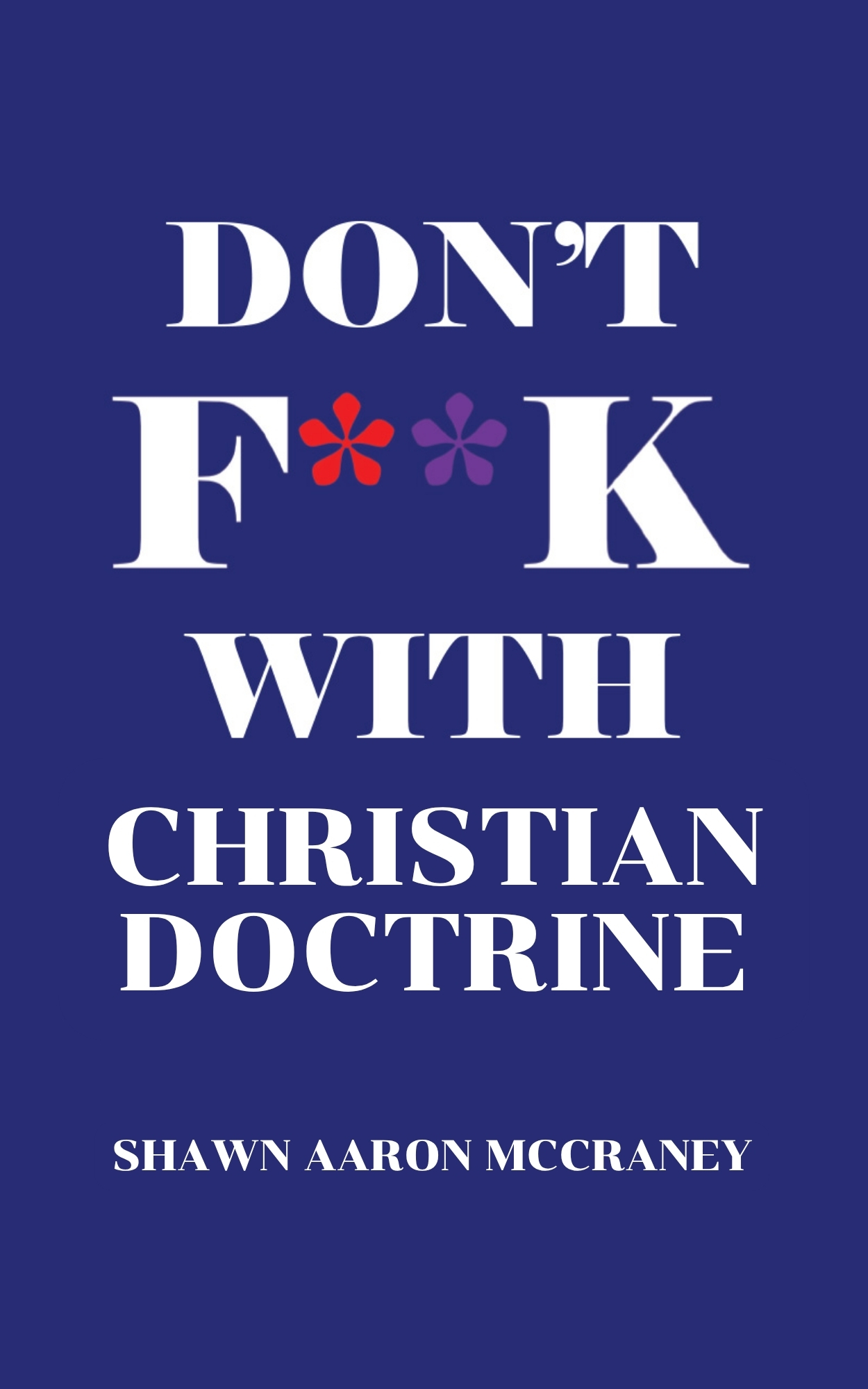
Don't F**k With Christian Doctrine
"Don't F**k With Christian Doctrine" by Shawn McCraney critiques the manipulation and institutionalization of Christian doctrine over centuries, arguing that dogmatic traditions have distorted biblical truth and replaced spiritual freedom with control for the sake of building the church. The book differentiates between theology and doctrine, highlighting how conflating them leads to confusion and how material religion's relevance ended nearly 2,000 years ago. It emphasizes and justifies that no denomination or leader holds a monopoly on truth, advocating for faith to be lived subjectively and for spiritual liberty to be found in love rather than theological conformity.

Sample: Introduction: Don't F**k With Christian Doctrine
Though the words doctrine and theology are often used interchangeably, there are some subtle differences of each noun that make them distinct. Theology is literally the study of God through His word (theos/logos) where doctrine represents the beliefs and practices that people and churches have established from His word. The differences sort-of boil down to “of” and “from” – theology is the study “of” and doctrine is the beliefs and practices are derived “from.” Of course, these terms are interchangeable with each other to a certain extent and certainly overlap when they are individually pursued.
In this book, we are going to sketch out the ways people have f**ked with the doctrines of the Christian faith, which are the results of what they have derived from the written Word of God.
Where theology is when someone says, “I think God wants us to love each other,” doctrine is when someone, borrowing from the Bible says, “the way we love each other is to forgive, to turn the other cheek, go the extra mile by serving the poor, etc.” Theological positions are pointed more to the grand view of things generally while doctrinal positions are more specific and demand the acceptance of a belief (and often a practice) of that demanded belief. Theology is wider, more fluid, and perhaps we could see it as a way to understand or comprehend God, His ways and will. Doctrine is more about proper beliefs and actions, and therefore doctrine is usually in the hand of different denominations as they are the ones that impose doctrinal demands on others.
To make matters a little more confusing, this little book is going to sort of straddle both terms, and we might even be guilty of amalgamating them as a means to expose how people have readily f**ked with Christian doctrine and therefore ultimately f**k with the biblical views of God. Mess up one area, we will probably mess up the other. By necessity we are forced to bring them in and speak to them almost as one.
We have a saying in our ministry that says:
“Nobody as all the facts, but at least we have the story right.”
What we mean by this is no religion on earth, and no individual or church or set of doctrines represent all of the facts about God, Christ and the Spirit to the world. Admittedly, we all see through a glass darkly, as Paul maintained. From this position we are then able to say that Catholics, Mormons, Jehovah’s Witnesses, Jews, Muslims, Baptist’s, Pentecostals, Christadelphians, Quakers and the rest all, to some extent or another, possess some facts about God but no one, or nothing, has a corner on them.
With this being the case, we suggest that all people, irrespective of the church they attend or denomination they support, are entitled to fellowship and love in the name and cause of Christian unity. All. No matter how odd or extreme their proclaimed “facts” may be.
But in the same breath, we ardently maintain that amidst of all these doctrinally based approaches, denominations and attempts to represent God, we do have the right story. In other words, we humbly maintain, from a reasonable, historical, exegetical analysis and application of scripture, that we rightly understand, in general, all that God has done for the world in the creation, the Nation of Israel and through the life, death, resurrection, ascension and return of His Son nearly 2000 years ago. From this general view, we know the right story to tell the world.
This is admittedly an extremely bold statement. But remember, we do not lay claim to possessing all the facts, have the perfect theology or corner on right doctrine. We readily admit that we can and have been wrong. So while we could misunderstand the creation, the flood, sabbath day, sacrifices, the ontology of God, the make-up of Christ, the nature of angels, soteriology and all the rest, our claim is that we do have the overall story of God reconciling to the world to himself, right. (2nd Corinthians 5:18-19)
From this position, we maintain that all religious expressions, with all of their doctrinal and practical demands, could better themselves if they at least got the story right – from there they can choose to continue to debate with each other over all of the facts but we have found that once the story is right, people begin to not care too much about the arguable details. It is from this position – of our having the story right – that we will now examine how people who have gotten the story wrong, innocently perhaps, and f**K with Christian doctrine.
Where our book on the Spirit was the shortest in our series, this book will be our most verbose.