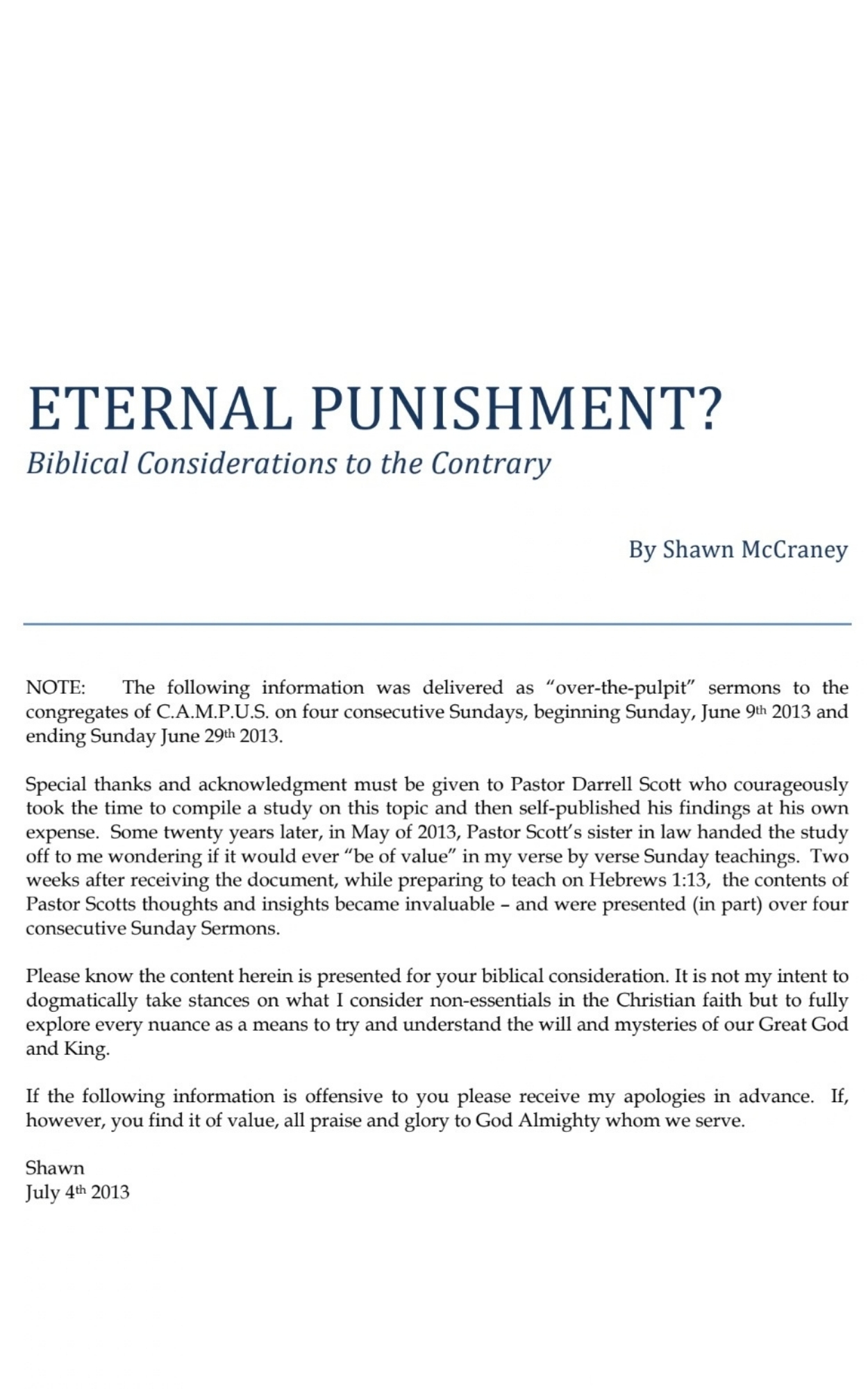
The Eternal Punishment Papers
Biblical Considerations To The Contrary
"The Eternal Punishment Papers" by Shawn McCraney is a book that critically examines biblical texts to challenge the traditional understanding of eternal damnation. It offers a fresh perspective on the interpretation of scriptures concerning the fate of the wicked, exploring theological arguments about the meaning of 'eternal' and the nature of God's justice and mercy. Aimed at theologians, biblical students, Christians questioning divine justice, and those interested in eschatology, the book provides a scripturally backed alternative view of God's ultimate plan, suggesting it may be more merciful than traditionally believed. It encourages readers to reconsider their understanding of faith and forgiveness.
Sample: First Sermon (A General Summary)
NOTE: The following information was delivered as “over-the-pulpit” sermons to the congregates of C.A.M.P.U.S. on four consecutive Sundays, beginning Sunday, June 9th 2013 and ending Sunday June 29th 2013.
Special thanks and acknowledgment must be given to Pastor Darrell Scott who courageously took the time to compile a study on this topic and then self-published his findings at his own expense. Some twenty years later, in May of 2013, Pastor Scott’s sister in law handed the study off to me wondering if it would ever “be of value” in my verse by verse Sunday teachings. Two weeks after receiving the document, while preparing to teach on Hebrews 1:13, the contents of Pastor Scotts thoughts and insights became invaluable – and were presented (in part) over four consecutive Sunday Sermons.
Please know the content herein is presented for your biblical consideration. It is not my intent to dogmatically take stances on what I consider non-essentials in the Christian faith but to fully explore every nuance as a means to try and understand the will and mysteries of our Great God and King.
If the following information is offensive to you please receive my apologies in advance. If, however, you find it of value, all praise and glory to God Almighty whom we serve.
Shawn McCraney
July 4th 2013
First Sermon (A General Summary)
Now, to wrap this up and wind you up, let’s go back to verse 13.
Here the writer produces yet ANOTHER proof that Jesus is superior to angels, asking the question,
“when has God ever said to an angel to sit on His right hand until he makes their enemies his footstool?”
Never.
This passage is taken from Psalm 90:1 which is a Psalm that is repeatedly quoted here in Hebrews and referring to the Messiah.
Interestingly enough, when Jesus was on earth He applied this passage to Himself (in Matthew 22:43,44).
Peter applied it to Him too (in Acts 2:34,35).
Notice something here though. The passage says that Christ will sit at the right hand of the Father UNTIL . . . He makes all His enemies his footstool.
“Until I reduce them entirely to a state of total subjection.”
A footstool is what we put under our feet when we sit on a chair and so the phrase here pictures that His enemies are entirely subdued.
Entirely . . . subdued.
Every knee bowed. Every tongue confessed.
I am going to lead you into some amazing imagery now – one I challenge all of you to prayerfully consider and studiously pursue. I’m not set on this at all, but there are things in my life leading me to wonder.
In first Corinthians 15 Paul touches on the topic of all things being subjected a bit more and this is what he says beginning at verse 23
23 “But every man in his own order: Christ the firstfruits; afterward they that are Christ's at his coming.
24 Then cometh the end, when he shall have delivered up the kingdom to God, even the Father; when he shall have put down all rule and all authority and power.
25 For he must reign, till he hath put all enemies under his feet.
26 The last enemy that shall be destroyed is death.
27 For he hath put all things under his feet. But when he saith all things are put under him, it is manifest that he is excepted, which did put all things under him. (LISTEN)
28 And when all things shall be subdued unto him, then shall the Son also himself be subject unto him that put all things under him, that God may be all in all.”
I do not want to terrify you at this point and completely unearth any shred of confidence you might have in my ability to teach, but these passages introduce something that we must consider.
Again, I am telling you that I am considering this because of these passages and much, much more.
We know hell is a reality. We know people go there and we know it is described paradoxically as a place of flame (even eternal flame) and torment but also a place of darkness.
We also know from scripture 1st Timothy 2:4 that says, speaking of God
“Who will have all men to be saved, and to come unto the knowledge of the truth.”
We know from scripture that Jesus atoned for the sins of the whole world, and we know from scripture that God does some amazing things to bring about as many as possible to saving truths.
Finally, we know that God elected the nation of Israel, as a people, to do certain things – bring forth the Law, the scripture, and the Messiah.
And when they were in the game they thought they were all that, that everything began and end with them, right?
They were reticent and surprised that the “great unwashed” Gentiles would be accepted of God, right? They still resist the notion.
But contrary to their ideas, the Lord did open the gates to all, didn’t He?
And Christ has gathered unto Himself a bride (or a church) – and we were elected to do certain things to help bring about God’s will, right?
Is it possible, that just as the Jews thought that they were all that and no others were allowed, that we, as the body of Christ, could be making the same mistake?
Is it possible that those who go to the lake of fire, once bowing and confessing, will too, come forth and bring to fruition God’s will that all men be saved?
More on this next week. In the meanwhile get into the word. Maybe we can talk more about this next week when we open.